



Mosquito Repellent: History, Science, and Emerging Innovations
Mosquito repellents are formulated to render surfaces unappealing to mosquitos. They contain a primary active ingredient that repels insects, plus secondary components that aid in delivery and enhance cosmetic appeal. While available in creams, lotions, and oils, the most common form on the market today is the aerosol spray.
Historical Overview
Early repellents drew on natural materials such as smoke, plant extracts, oils, tars, and muds. As research advanced, scientists isolated specific compounds, leading to more effective, synthetic options. The first widely recognized repellent was citronella oil, a fragrant herbal extract from an Asian grass. Although its mosquito‑repellent properties were discovered in 1901 by accident, its high volatility and the large quantities required limited its practicality.
Military research in the 1920s and 1930s produced synthetic candidates like dimethyl phthalate (1929), indalone (1937), and Rutgers 612 (2‑ethyl‑1,3‑hexane diol). Each had niche effectiveness but fell short of broad adoption. The breakthrough came in 1955 with the synthesis of DEET (n‑n‑diethyl‑m‑toluidamide), which remains the gold‑standard active ingredient in most commercial repellents.
How Repellents Work
Repellents disrupt a mosquito’s olfactory homing system located on its antennae. Lactic acid, a natural marker emitted by warm‑blooded hosts, activates these receptors. When a repellent such as DEET is applied, it evaporates and competitively blocks lactic acid binding, effectively “hiding” the user from mosquito detection. Because the active compound must evaporate, protection lasts only for a limited period.
Key Ingredients
For a repellent to be effective, it must:
- Maintain protection for many hours across diverse surfaces.
- Perform reliably under varied environmental conditions.
- Be non‑toxic and non‑irritating to human and animal skin.
- Be cosmetically acceptable with pleasant scent and feel.
- Leave no residue on clothing.
- Be cost‑effective and also deter other pests such as flies.
DEET dominates the market, typically comprising 5‑30% of the final formulation. Other active ingredients include citronella oil, dimethyl phthalate, lavender, lemon‑grass oil, and peppermint oil. Mixtures of multiple compounds often yield superior protection.
Inert components vary with product form. Aerosols contain solvents (ethanol or propanol), propellants (liquefied hydrocarbons, hydrofluorocarbons, or dimethyl ether), fragrances, emollients, and corrosion inhibitors. Creams and lotions rely on water, surfactants, fatty alcohols, fragrances, and emollients, offering dual benefits of repellency and skin moisturization but typically delivering less potent protection due to slower evaporation.
Manufacturing Process
Production typically involves two stages: compounding and filling. Aerosol manufacturing is illustrated below; other formats follow similar principles with less complex filling steps.
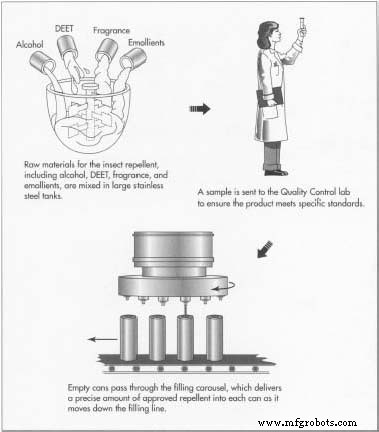
Compounding
- Raw materials are blended in large stainless‑steel tanks. Alcohol, DEET, fragrance, and emollients are combined; propellant is added later.
- Safety protocols (spark‑proof outlets, blast‑proof walls) protect against flammable hazards.
- A sample undergoes quality‑control testing before proceeding to the filling line.
Filling
- Empty tin‑plate steel cans are fed onto a conveyor, cleaned, and oriented for filling.
- Piston filling heads deliver precise volumes into each can.
- Valves are inserted, sealed, and propellant injected under high pressure.
- Hot‑water bath tests for leaks and structural integrity, followed by air‑jet drying.
- Actuator buttons, overcaps, labels, and printing are added.
- Finished cans are boxed (12 per box), palletized, and shipped to distributors at rates exceeding 200 cans per minute.
Quality Assurance
Quality control spans the entire production chain. Incoming raw materials are tested for pH, specific gravity, moisture, and physical integrity. Throughout manufacturing, samples are analyzed for active‑ingredient concentration, pressure, spray rate, and pattern. Long‑term stability studies verify resistance to corrosion and consistent performance over time.
Future Directions
While DEET and citronella oil remain widely used, concerns over skin irritation and rare severe reactions, especially in children, have spurred research into safer alternatives. One promising approach involves microencapsulation of DEET, which could shield users from direct exposure while preserving efficacy. Continued investigation and rigorous testing will determine whether these innovations can meet the high standards of safety and performance required for consumer use.
Manufacturing process
- What is VMC Machining? An Expert Overview of Vertical Machining Centers
- Expert Guide to Aluminum Laser Marking: Precision, Durability, and Industry Applications
- MIG vs. TIG Welding: Selecting the Right Arc Welding Technique for Your Project
- Comprehensive Guide to Laser Marking: Types, Benefits, and Applications
- Key Considerations for High‑Volume Swiss Machining
- CNC Prototyping Guide: Precision, Speed, and Cost‑Effective Production
- Expert Shaft Manufacturing: Precision Processes & Custom Solutions
- Fiber Laser Marking: Precision, Speed, and Versatility for Modern Industries
- Electropolishing vs. Passivation: Choosing the Right Stainless Steel Finishing
- Mosquito Repellent: History, Science, and Emerging Innovations