



Mastering the C for Loop: Syntax, Mechanics, and Practical Examples
Mastering the C for Loop: Syntax, Mechanics, and Practical Examples
Discover how to write, understand, and leverage the C for loop with clear explanations and hands‑on code examples.
A loop is a control structure that repeats a block of code until a specified condition becomes false. In C, there are three primary looping constructs:
- for loop
- while loop
- do…while loop
This tutorial focuses exclusively on the for loop. Stay tuned for our next posts covering while and do…while loops.
Understanding the for Loop
The canonical syntax, as defined by the C11 standard, is:
for (initialization; test; update) {
    /* loop body */
}
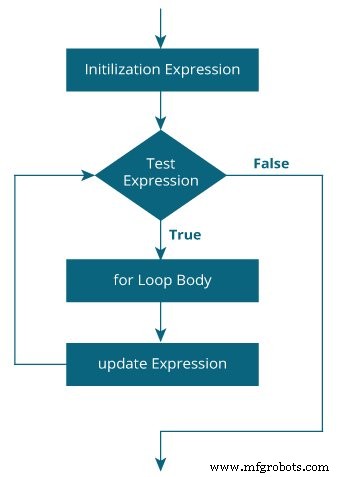
Each component plays a distinct role:
- Initialization runs once before the loop starts.
- Test is evaluated before each iteration; if false, the loop exits.
- Update executes after each iteration, typically modifying the loop counter.
How the for Loop Works
- The initialization statement is executed a single time.
- The test expression is evaluated. If it evaluates to
false, the loop terminates. - If true, the loop body runs, then the update expression executes.
- The process repeats until the test becomes false.
For a deeper dive into logical conditions, review C’s relational and logical operators.
Loop Flowchart
Example 1: Printing Numbers 1–10
#include <stdio.h>

int main(void) {
    for (int i = 1; i <= 10; ++i) {
        printf("%d ", i);
    }
    return 0;
}
Output
1 2 3 4 5 6 7 8 9 10
Step‑by‑step breakdown:
iis initialized to 1.- The test
i <= 10is true, soi(1) is printed. - The update
++iincrementsito 2, and the loop repeats. - This continues until
ibecomes 11, at which point the test fails and the loop ends.
Example 2: Sum of the First N Natural Numbers
#include <stdio.h>

int main(void) {
    int num, count, sum = 0;

    printf("Enter a positive integer: ");
    scanf("%d", &num);

    for (count = 1; count <= num; ++count) {
        sum += count;
    }

    printf("Sum = %d\n", sum);
    return 0;
}
Output
Enter a positive integer: 10
Sum = 55
Explanation:
- Variable
numstores the user’s input. countstarts at 1. The testcount <= numis true, sosumbecomes 1.- After
++count,countis 2; the test remains true, adding 2 tosum(now 3). - Iteration continues until
countreaches 11, when the test fails and the loop stops. - The final
sum(55) is printed.
Next up: we’ll explore the while and do…while loops for additional control flow patterns.
Mastering C Conditional Statements: If, Else, and More
Mastering While and Do‑While Loops in C: Practical Examples
C Language
- Mastering C# While and Do‑While Loops: Syntax, Examples, and Best Practices
- Mastering C# For Loops: Syntax, Flow, and Practical Examples
- C# foreach Loops: Iterate Arrays and Collections with Ease
- Master C++ For Loops: A Step-by-Step Guide
- Mastering Python For Loops: Syntax, Examples, and Advanced Patterns
- Master Java For Loops: Syntax, Examples, and Best Practices
- C++ For Loops Explained: Syntax, Workflow, and Practical Examples
- Master C Loops: For, While, and Do‑While Explained with Practical Examples
- Java Program to Identify Armstrong Numbers Using For Loop
- Mastering For Loops in Verilog: Build Reusable Hardware Logic