



Master C Loops: For, While, and Do‑While Explained with Practical Examples
What Is a Loop in C?
A loop repeats a block of statements until a specified condition becomes false. In C, a loop consists of a body and a control statement that dictates how many times the body executes. Mastering loops is essential for writing efficient and readable C programs.
In this tutorial you’ll discover:
- Definition and purpose of loops in C
- Types of loops: entry‑controlled vs. exit‑controlled
- While loop fundamentals
- Do‑while loop fundamentals
- For loop fundamentals
- Using
breakandcontinue - Choosing the right loop for a given scenario
Types of Loops in C
C loops are classified by the position of their control condition:
- Entry‑controlled loops – the condition is evaluated before the body runs (e.g.,
whileandfor). - Exit‑controlled loops – the condition is evaluated after the body runs (e.g.,
do‑while).
An infinite loop occurs when the loop never satisfies its termination condition. Common causes include missing a termination check or an always‑true condition.
While Loop in C
The while loop is the simplest form of an entry‑controlled loop. Its syntax is:
while (condition) {
    statements;
}
The condition is evaluated first; if it is true, the body executes. After each execution, the condition is re‑evaluated until it becomes false.
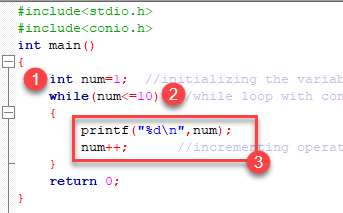
Example – print numbers 1 to 10:
#include <stdio.h>
int main() {
    int num = 1;
    while (num <= 10) {
        printf("%d\n", num);
        num++;
    }
    return 0;
}
Output:
1
2
3
4
5
6
7
8
9
10
Do‑While Loop in C
The do‑while loop guarantees that the body executes at least once, making it an exit‑controlled loop. Syntax:
do {
    statements;
} while (condition);
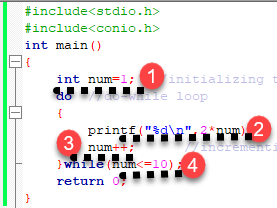
Example – print the multiplication table of 2 up to 10:
#include <stdio.h>
int main() {
    int num = 1;
    do {
        printf("%d\n", 2 * num);
        num++;
    } while (num <= 10);
    return 0;
}
Output:
2
4
6
8
10
12
14
16
18
20
For Loop in C
The for loop is highly efficient for iterating with a known start, end, and step. Syntax:
for (initialization; condition; increment) {
    statements;
}
- The initialization runs once.
- The condition is checked before each iteration.
- The increment updates the loop variable.
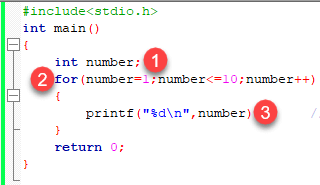
Example – print numbers 1 to 10:
#include <stdio.h>
int main() {
    for (int number = 1; number <= 10; number++) {
        printf("%d\n", number);
    }
    return 0;
}
Output:
1
2
3
4
5
6
7
8
9
10
Complex for loops can include multiple expressions and even empty components:
for (int i = 0, j = num; i < j; i++, j--) {
    // statements
}
Nested loops are common, especially for multidimensional arrays. Example – multiplication tables:
#include <stdio.h>
int main() {
    int i, j;
    int table = 2;
    int max = 5;
    for (i = 1; i <= table; i++) {
        for (j = 0; j <= max; j++) {
            printf("%d x %d = %d\n", i, j, i * j);
        }
        printf("\n");
    }
    return 0;
}
Output:
1 x 0 = 0
1 x 1 = 1
1 x 2 = 2
1 x 3 = 3
1 x 4 = 4
1 x 5 = 5

2 x 0 = 0
2 x 1 = 2
2 x 2 = 4
2 x 3 = 6
2 x 4 = 8
2 x 5 = 10
Break Statement in C
The break keyword exits the nearest enclosing loop or switch statement immediately. Example – stop a while loop when a value reaches 3:
#include <stdio.h>
int main() {
    int num = 5;
    while (num > 0) {
        if (num == 3)
            break;
        printf("%d\n", num);
        num--;
    }
    return 0;
}
Output:
5
4
Continue Statement in C
The continue keyword skips the rest of the current iteration and proceeds to the next loop cycle. Example – skip printing the number 5:
#include <stdio.h>
int main() {
    int nb = 7;
    while (nb > 0) {
        nb--;
        if (nb == 5)
            continue;
        printf("%d\n", nb);
    }
    return 0;
}
Output:
6
4
3
2
1
Choosing the Right Loop
Decide based on when the condition should be evaluated:
- Pre‑test required – use
whileorfor. - Post‑test required – use
do‑while.
Summary
- A loop repeats a block of code until its condition becomes false.
- C offers three primary loops:
while,do‑while, andfor. - Entry‑controlled loops evaluate the condition before each iteration; exit‑controlled loops evaluate after.
- Use
breakto terminate loops early andcontinueto skip iterations. - Choose the loop that best matches the control‑flow requirements of your algorithm.
C Language
- Mastering C# While and Do‑While Loops: Syntax, Examples, and Best Practices
- Mastering C# For Loops: Syntax, Flow, and Practical Examples
- Master C++ For Loops: A Step-by-Step Guide
- Mastering the C for Loop: Syntax, Mechanics, and Practical Examples
- Mastering While and Do‑While Loops in C: Practical Examples
- Mastering Python's While Loop: Syntax, Examples, and Best Practices
- C# Control Flow: IF, SWITCH, FOR, WHILE – Practical Examples & Explanations
- Master Python Loops: For, While, Break, Continue, and Enumerate Explained
- Mastering C Loops: A Comprehensive Guide to Repetition Control
- Master C# Loops: Efficient Code Repetition Techniques