



Mastering Python's While Loop: Syntax, Examples, and Best Practices
Python While Loop
The while loop is a cornerstone of iterative programming in Python, executing a block of code repeatedly as long as a specified condition remains true.
Video: Python while Loop
What is a while loop in Python?
A while loop evaluates a boolean expression before each iteration. If the expression evaluates to True, the loop’s body runs; otherwise, the loop terminates. This construct is ideal when the number of iterations is not known in advance.
Syntax of a while loop in Python
while test_expression:
    body_of_loop
The test expression is evaluated first. Only when it evaluates to True does Python execute the indented block. After each iteration, the condition is re‑evaluated. The loop stops when the condition becomes False. Python determines the truthiness of values: non‑zero numbers and non‑empty containers are True, while 0, None, and empty containers are False.
Flowchart of a while loop
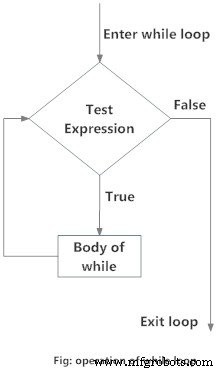
Example: Summing Natural Numbers with a While Loop
# Program to add natural numbers up to n
# n = int(input("Enter n: "))  # Interactive input
n = 10
# Initialize sum and counter
sum = 0
i = 1
while i <= n:
    sum += i
    i += 1    # Update counter
print("The sum is", sum)
Running the program outputs:
Enter n: 10
The sum is 55
The loop continues while i <= n remains true. Updating the counter inside the loop is essential; omitting it would create an infinite loop.
Using Else with a While Loop
Like the for loop, while can include an optional else clause that runs only when the loop condition becomes False without encountering a break statement.
'''Illustrating the else clause with a while loop'''
counter = 0
while counter < 3:
    print("Inside loop")
    counter += 1
else:
    print("Inside else")
Output
Inside loop
Inside loop
Inside loop
Inside else
In this example, the else block executes after the loop condition fails (counter reaches 3). If a break were used, the else block would be skipped.
Python
- Mastering C# While and Do‑While Loops: Syntax, Examples, and Best Practices
- Mastering While and Do‑While Loops in C: Practical Examples
- Mastering Python Operators: A Comprehensive Guide
- Mastering Python For Loops: Syntax, Examples, and Advanced Patterns
- Mastering Python Loop Control: break & continue
- Python List Operations: Creation, Access, Modification, and Advanced Techniques
- Mastering Python Tuples: Creation, Access, and Advanced Operations
- Mastering Java While & Do‑While Loops: Step‑by‑Step Tutorial
- Master Python Loops: For, While, Break, Continue, and Enumerate Explained
- Master Python Loops: Control Flow & Repetition Techniques