



Understanding Switch‑Case in C: Syntax, Examples, and Best Practices
What Is the Switch Statement in C?
The switch construct evaluates a single expression and routes program flow to the matching case label. If no match is found, the optional default block runs. This decision‑making tool is especially useful when handling discrete, constant values such as menu options, error codes, or user selections.
Each case is uniquely identified by a constant expression. When the expression’s value matches a case label, the corresponding block of statements executes, and execution exits the switch (unless a break is omitted, which causes fall‑through).
Switch‑Case Syntax
switch (expression) {
    case constant1:
        // statements
        break;
    case constant2:
        // statements
        break;
    // …
    default:
        // statements
        break;
}
// statements following the switch
- The
expressionmust evaluate to an integral or enum type. - Case labels are constant values; duplicates create ambiguity and should be avoided.
- Each
caseends with a colon and is followed by a block of code. - Use
breakto terminate a case; without it, execution continues into subsequent cases (fall‑through). - The
defaultblock is optional and runs only when no case matches.
How the Switch Statement Works
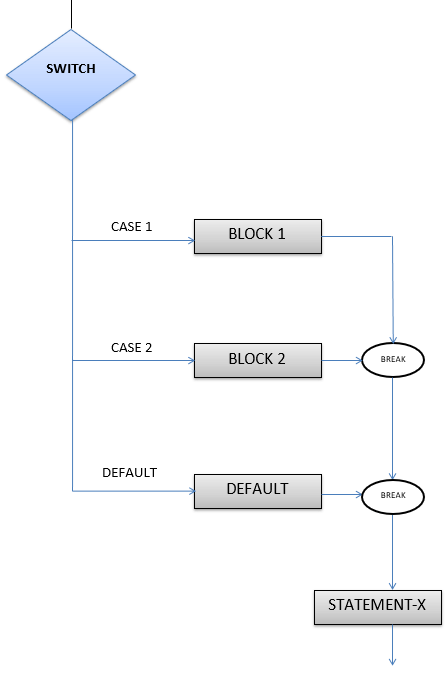
The following flowchart illustrates the decision process for a switch statement:
Example 1: Basic Switch
#include <stdio.h>
int main() {
    int num = 8;
    switch (num) {
        case 7:
            printf("Value is 7");
            break;
        case 8:
            printf("Value is 8");
            break;
        case 9:
            printf("Value is 9");
            break;
        default:
            printf("Out of range");
            break;
    }
    return 0;
}
Output:
Value is 8
Example 2: Using Default
#include <stdio.h>
int main() {
    int language = 10;
    switch (language) {
        case 1:
            printf("C#\n");
            break;
        case 2:
            printf("C\n");
            break;
        case 3:
            printf("C++\n");
            break;
        default:
            printf("Other programming language\n");
    }
    return 0;
}
Output:
Other programming language
Example 3: Combined Cases
#include <stdio.h>
int main() {
    int number = 5;
    switch (number) {
        case 1:
        case 2:
        case 3:
            printf("One, Two, or Three.\n");
            break;
        case 4:
        case 5:
        case 6:
            printf("Four, Five, or Six.\n");
            break;
        default:
            printf("Greater than Six.\n");
    }
    return 0;
}
Output:
Four, Five, or Six.
Nested Switches
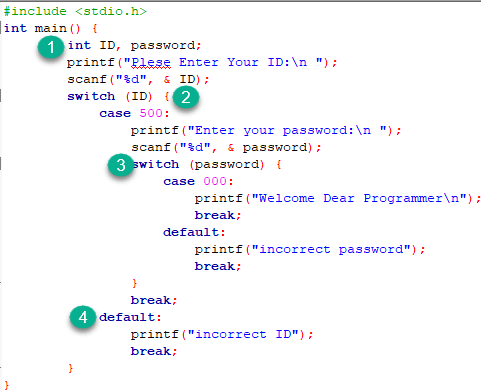
Switches can be nested, allowing hierarchical decision making. The following example demonstrates a simple authentication flow:
#include <stdio.h>
int main() {
    int ID, password;
    printf("Please Enter Your ID:\n");
    scanf("%d", &ID);
    switch (ID) {
        case 500:
            printf("Enter your password:\n");
            scanf("%d", &password);
            switch (password) {
                case 0:
                    printf("Welcome Dear Programmer\n");
                    break;
                default:
                    printf("Incorrect password\n");
            }
            break;
        default:
            printf("Incorrect ID\n");
    }
    return 0;
}
OUTPUT:
 Please Enter Your ID:
 500
 Enter your password:
 000
 Welcome Dear Programmer
Why Switch Is Preferable to Extensive If‑Else
While if‑else chains can achieve the same logic, they grow unwieldy as the number of options increases. Switch statements offer clearer syntax, better readability, and can be optimized by the compiler into jump tables for constant expressions.
Rules for Using Switch
- The controlling expression must be an integral or enum type.
- Case labels must be constant, unique values.
- Each case label ends with a colon.
- Use
breakto prevent unintended fall‑through. - Only one
defaultlabel is allowed. - Nested switches are allowed and often useful.
Key Takeaways
- Switch is a robust decision‑making tool for discrete values.
- Always include a
break(unless intentional fall‑through). - Keep case labels unique and constant.
- The
defaultblock is optional but recommended for error handling. - Nested switches provide layered decision logic.
C Language
- Circuit With a Switch: A Practical Guide to Basic Electrical Circuits
- Mastering the C# Switch Statement: Syntax, Examples & Best Practices
- Mastering the C++ Switch‑Case Statement: Syntax, Workflow, and Practical Examples
- Mastering the C Switch Statement: Syntax, Flow, and Practical Example
- Mastering the Java Switch Statement: Syntax, Usage, and Best Practices
- Mastering C++ Switch‑Case: Syntax, Usage, and Practical Examples
- C# Hashtable Explained: Key-Value Storage, Operations, and Practical Examples
- Java Switch‑Case Statement Explained: Syntax, Examples, and Best Practices
- Python Print() Function: A Practical Guide with Examples
- Understanding Verilog Case Statements: Efficient Multiplexer Implementation