



Flask vs Django: Key Differences, Features, and Choosing the Right Framework
In this comprehensive guide we break down the differences between Flask and Django, the two most popular Python web frameworks. By exploring their core concepts, feature sets, strengths, and trade‑offs, you’ll be able to pick the right tool for your project.
What Is Flask?
Flask is a lightweight micro‑framework that provides the essential building blocks for web applications. It ships with no mandatory dependencies, allowing developers to add only the extensions they need—form validation, ORMs, authentication, file uploads, and more. Flask’s minimalism makes it ideal for small to medium projects and for developers who want fine‑grained control over their stack.
What Is Django?
Django is a batteries‑included, high‑level framework designed for rapid, scalable development of complex, data‑driven sites. It comes with an ORM, authentication, admin interface, and a robust set of tools that streamline common web tasks. Django’s convention‑over‑configuration philosophy reduces setup time and promotes best practices.
Key Differences at a Glance
- Flask supports API development out of the box; Django traditionally relies on the Django REST Framework.
- Flask’s dynamic HTML rendering is optional; Django provides built‑in template rendering.
- Flask is ideal for fast, lightweight services; Django excels in full‑stack, monolithic applications.
- Flask offers a modular, flexible architecture; Django follows a monolithic, opinionated structure.
- URL routing in Flask is REST‑style; Django uses regex‑based URLconf.
- Flask is a WSGI toolkit; Django is a complete full‑stack framework.
Features of Flask
- Integrated unit‑testing support.
- RESTful request dispatching.
- Jinja2 templating engine.
- Built on Werkzeug.
- Secure client‑side sessions via signed cookies.
- Comprehensive documentation.
- Compatible with Google App Engine.
- Clear, consistent API design.
- Simple deployment to production.
Features of Django
- Model‑View‑Template (MVT) architecture.
- Rich libraries for imaging, graphics, scientific computing.
- Support for multiple databases.
- Cross‑platform compatibility.
- Optimized for specialized server deployments.
- Front‑end integrations (Ajax, jQuery, Pyjamas).
- Multilingual and multi‑character support.
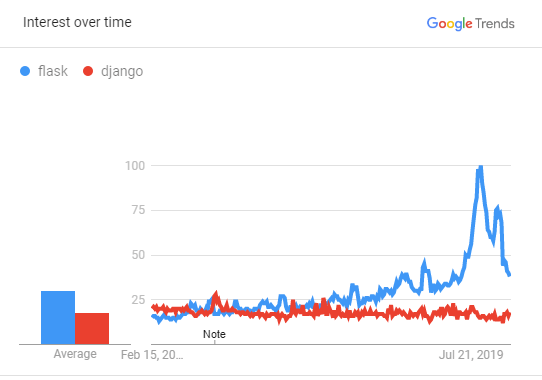
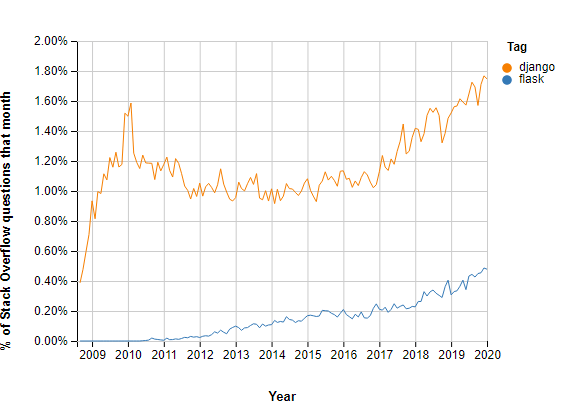
Flask vs Django: A Detailed Comparison
| Flask | Django |
|---|---|
| Created in 2010 | Created in 2005 |
| Designed for rapid, lightweight development | Designed for straightforward, full‑stack projects |
| WSGI‑based micro‑framework | Full‑stack web framework |
| Built‑in API support | API support via Django REST Framework |
| Visual debugging available | No native visual debugger |
| Multiple database engines supported | Multiple database engines supported |
| No default form library; WTForms can be added | Built‑in form system tightly coupled with ORM |
| No dynamic HTML by default | Dynamic HTML via templates |
| Request object imported globally | Each view receives the request as a parameter |
| Relatively young framework | Highly mature and stable |
| Flexible architecture | Monolithic architecture |
| Extensible via third‑party extensions | Large ecosystem of Django apps |
| Project layout is flexible | Conventional layout enforced |
| Jinja2 templating engine | Own template engine with powerful tags |
| RESTful URL routing | Regex‑based URL routing |
| No built‑in bootstrap tool | Django‑admin bootstraps projects |
| Great for lightweight codebases | Robust documentation and community support |
| Best for single‑app projects | Supports multi‑app projects seamlessly |
| Limited third‑party app support | Extensive third‑party app ecosystem |
| GitHub stars: 48.8 k | GitHub stars: 47.1 k |
| Lightweight, open source, minimal coding overhead | Rapid development, open source, strong community |
| Used by Netflix, Reddit, Lyft, MIT | Used by Instagram, Coursera, Udemy |
Pros of Flask
- High compatibility with modern technologies.
- Ideal for experimentation and rapid prototyping.
- Easy to learn for simple projects.
- Small core footprint; highly extensible.
- Scalable for straightforward applications.
- Clear URL routing.
- Maintains a concise codebase.
- Extensive community resources on GitHub.
Pros of Django
- Zero‑configuration setup and immediate runtime.
- Built‑in admin interface for quick CRUD.
- Internationalization built into the framework.
- Integrated testing framework.
- Automatic API documentation via DRF.
- Robust authentication and rate‑limiting features.
- Clear URL pattern definition.
- Comprehensive authentication system.
- Flexible caching backend options.
- High‑level framework for rapid web development.
- All‑in‑one toolset.
- ORM maps Python classes to database tables.
Cons of Flask
- Slower MVP turnaround for complex projects.
- Higher maintenance for large codebases.
- Complexity increases with scale.
- Asynchronous support is still evolving.
- No built‑in ORM; requires third‑party integration.
- Large projects demand architectural planning.
- Smaller community compared to Django.
Cons of Django
- Monolithic design may feel restrictive.
- Heavy reliance on Django ORM.
- Limited flexibility in component selection.
- May lag in adopting the latest tech trends.
- Steeper learning curve for beginners.
- Large code footprint can be overkill for small apps.
- Templates may fail silently if misconfigured.
- Server restarts on every code change.
- Requires regex knowledge for URL patterns.
- Deep coupling of internal components.
- Deploying multiple components can be confusing.
Which Framework Is Better for Your Project?
- Choose Flask for granular control, lightweight services, or when you want to hand‑pick every dependency.
- Opt for Django when you need a robust admin, rapid full‑stack development, or a proven ecosystem of third‑party apps.
- Build a small CRUD app with both frameworks to gauge familiarity and fit for your team.
Python
- Cloud vs. Virtualization: Key Differences & Business Impact
- Sensors vs. Transducers: Clear Differences & Practical Applications
- FRP vs Fiberglass: Understanding the Key Differences and Industrial Benefits
- Bolts vs. Screws: How to Choose the Right Fastener for Your Project
- Understanding the Difference Between Tube Steel (TS) and Hollow Structural Steel (HSS)
- Python vs PHP: Key Differences, Strengths, and Choosing the Right Language
- Python 2 vs Python 3: Key Differences and Choosing the Right Version
- CNC vs VMC: Understanding the Key Differences
- Choosing the Right Motor: Key Differences Between AC and DC Motors
- CNC vs NC: Understanding the Key Differences in Numerical Control Technology