



Tapped vs. Stud Leveling Feet: Which Stabilization System Is Best for Your Equipment?
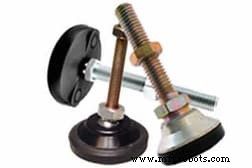
When selecting leveling feet for industrial machinery, understanding the distinction between tapped and stud options is essential. Both types provide the same fundamental benefit—stabilizing equipment and reducing vibration—but their design and installation differ in ways that can impact performance, maintenance, and flexibility.
What Are Tapped Leveling Feet?
Tapped feet feature a threaded shaft that is intended to be screwed onto a pre‑existing bolt on the machine. The bolt’s external threads engage with the foot’s internal threads, allowing the foot to be tightened directly onto the equipment. This configuration is often chosen for spaces where an additional bolt cannot be installed or where the existing bolt is already the optimal attachment point.
What Are Stud Leveling Feet?
Stud feet come with a built‑in bolt (the “stud”) that is pre‑threaded to match the machine’s mounting shaft. Installation is simply a matter of aligning the stud with the machine’s threaded axis and tightening it in place. Because the bolt is integral to the foot, there is no need to drill or add a separate bolt, which can reduce installation time and potential points of failure.
Key Differences Between Tapped and Stud Leveling Feet
1. Thread Orientation: Tapped feet use an internal (female) thread, while stud feet provide an external (male) bolt. This difference determines whether you need an existing bolt or can rely on the foot’s own stud.
2. Installation Flexibility: Stud feet offer greater adjustability because the built‑in bolt allows fine‑tuning of height and angle without re‑threading. Tapped feet may require more effort to adjust, especially if the machine’s bolt is fixed.
3. Durability and Maintenance: With stud feet, the engagement between the foot and machine is protected from repeated bolt removal, reducing wear on the machine’s mounting surfaces. Tapped feet can experience thread wear if the bolt is frequently loosened and tightened.
4. Application Suitability: Tapped feet are ideal when you must retrofit an existing bolt or when you need a foot that can be swapped out quickly. Stud feet are preferred in new installations or when maximum stability and ease of adjustment are priorities.
Ultimately, both tapped and stud leveling feet deliver reliable machine stabilization. The choice hinges on your specific installation context, the need for adjustment precision, and long‑term maintenance considerations.
Industrial equipment
- Understanding Glides: Enhancing Mobility with Leveling Feet
- Thermoplastic vs. Thermoset: Understanding Key Differences in Polymer Materials
- Wheels vs. Casters: Understanding the Key Differences
- Choosing the Ideal Leveling Feet for Furniture and Machinery
- Why Leveling Feet Are Essential for Machine Stability and Workplace Safety
- O‑Rings vs. Gaskets: Understanding Their Roles and Key Differences
- Iron vs. Steel: Key Differences Explained
- Milling vs. Grinding: Key Differences Explained
- Washers vs. Gaskets: Key Differences Explained
- DC vs. AC Motors: Key Differences and Choosing the Right One for Your Application