



O‑Rings vs. Gaskets: Understanding Their Roles and Key Differences
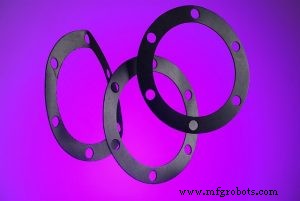
O‑rings and gaskets are essential components that create a reliable seal between two or more parts. From industrial machinery to household plumbing, these seals prevent leaks and maintain system integrity.
When multiple parts are joined, a properly selected seal—whether an O‑ring or a gasket—restores the joint’s integrity, stopping liquids, gases, or air from escaping. Though they share this core purpose, their designs and materials differ.
What Is an O‑Ring?
An O‑ring, also called a packing joint, is a circular elastomeric ring that compresses against a mating surface to form a seal. O‑rings can be engineered to withstand pressures exceeding 5,000 psi, ensuring durability even under extreme conditions. Their toroidal shape makes them ideal for cylindrical components such as pipes, valves, and shafts.
What Is a Gasket?
A gasket is a flat or custom‑shaped seal made from a wide range of materials—elastomers, metals, composites, or even paper. Unlike O‑rings, which are strictly elastomeric and circular, gaskets can be tailored to complex mating geometries. In automotive engines, for instance, a metal head gasket bonds the cylinder head to the block, whereas in a simple pipe joint a gasket might be a sheet of rubber or metal foil.
Because gaskets come in diverse shapes and materials, they can accommodate multiple surfaces and varied pressure regimes. When a joint involves more than two components or irregular surfaces, a custom gasket often outperforms a standard O‑ring.
Key Takeaways
Both O‑rings and gaskets seal joints, but the choice hinges on shape, material, and application. O‑rings are perfect for circular, pressure‑resistant seals, while gaskets—flat or custom—handle a broader range of configurations and materials.
Industrial equipment
- Thermoplastic vs. Thermoset: Understanding Key Differences in Polymer Materials
- Wheels vs. Casters: Understanding the Key Differences
- Forehand vs Backhand Welding: Key Differences and When to Use Each Technique
- Iron vs. Steel: Key Differences Explained
- Cut vs Wire Nails: Understanding the Key Differences for Construction
- Plasma vs. Laser Cutting: Key Differences and When to Use Each
- Lathe vs Milling Facing: Understanding the Key Differences
- Milling vs. Grinding: Key Differences Explained
- Washers vs. Gaskets: Key Differences Explained
- DC vs. AC Motors: Key Differences and Choosing the Right One for Your Application