



Swivel vs. Pivoting Hoist Rings: Choosing the Right Type for Safe Lifting
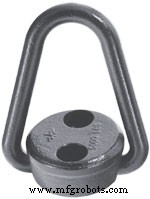
When lifting heavy objects, a hoist ring—a robust, looped metal component—is indispensable. It attaches to the load, while the hoist’s chain or rope connects to the ring, allowing the load to be raised safely and efficiently. There are two primary categories of hoist rings: swivel and pivoting. Understanding their differences is key to selecting the appropriate ring and preventing common issues such as chain tangles.
Swivel Hoist Ring
A swivel hoist ring features a free‑spinning loop that rotates around a fixed mounting point, such as a threaded screw. This design lets the ring pivot fully on its axis while the mounting mechanism remains stationary. Because the ring can rotate 360°, it keeps the chain or rope from winding around the load, even when the load swings or moves during lifting. This property reduces the risk of tangled chains, improves load stability, and enhances operator safety—making swivel rings the preferred choice for many industrial and construction applications.
Pivoting Hoist Ring
A pivoting hoist ring, by contrast, allows the loop to swing only forward and backward along a single plane. The mounting point is still fixed, but the ring’s motion is limited to a back‑and‑forth pivot. While this restriction can expose the ring to slightly more stress, it is perfectly adequate for many hoisting scenarios where the load does not swing significantly or where chain tangles are unlikely. Pivoting rings are often chosen for cost‑effective, low‑profile lifting tasks where the load’s movement is predictable.
In summary, choose a swivel ring when you need to eliminate chain tangles and maintain a straight rope or chain, and opt for a pivoting ring for simpler, more controlled lifting situations. Selecting the right ring type not only improves efficiency but also upholds safety standards on the job site.
Industrial equipment
- What Are Retaining Rings? Understanding Their Design and Applications
- Thermoplastic vs. Thermoset: Understanding Key Differences in Polymer Materials
- Wheels vs. Casters: Understanding the Key Differences
- O‑Rings vs. Gaskets: Understanding Their Roles and Key Differences
- Forehand vs Backhand Welding: Key Differences and When to Use Each Technique
- Iron vs. Steel: Key Differences Explained
- Milling vs. Grinding: Key Differences Explained
- Washers vs. Gaskets: Key Differences Explained
- DC vs. AC Motors: Key Differences and Choosing the Right One for Your Application
- Cranes vs. Hoists: Key Differences to Guide Your Equipment Choice