



What Are Retaining Rings? Understanding Their Design and Applications
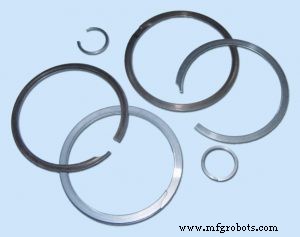
Retaining rings are specialized temporary fasteners widely used in housing assemblies. Unlike conventional screws or bolts, they are designed to hold multiple components together during the initial build and are removed once the assembly is complete.
Overview of Retaining Rings
A retaining ring is typically a spiral or semi‑circular metal band that provides a shoulder or rim inside a cylindrical housing. Because housing interiors are often smooth, components cannot be secured without this intermediary. The ring’s geometry locks the parts in place, preventing axial or radial movement.
While the core function is the same, several varieties exist to meet specific design requirements:
- Tapered retaining rings – fit snugly into tapered housings.
- Axially assembled rings – install along the axis of the housing.
- Radially assembled rings – fit around the circumference of the housing.
- Self‑locking rings – feature a locking profile that resists removal.
- Snap rings – snap into place without tools.
- Spiral rings – continuous spiral design for high‑precision fit.
- Push‑on rings – slide into place during assembly.
Materials and Finishes
Retaining rings are engineered from high‑strength metals such as carbon steel, stainless steel, or copper. To extend service life, they can receive protective coatings—phosphating, zinc‑plating, or epoxy—that shield the metal from moisture and corrosion. These finishes are especially important in automotive, aerospace, and marine environments.
How They Operate
During assembly, the ring is seated inside the housing, creating a mechanical barrier. Components are then positioned against the ring’s shoulder, which keeps them from sliding out. Once the final fasteners are tightened, the ring is typically removed, leaving a permanently secured assembly.
Key Takeaways
Retaining rings are essential for precision engineering: they are temporary, yet critical, fasteners that simplify the assembly of complex housings. By selecting the appropriate type, material, and finish, engineers can ensure reliable performance and longevity.
Industrial equipment
- Choosing the Right Hoist Ring: 5 Key Factors for Safe and Efficient Lifting
- Diamond Turning: Precision Machining for Advanced Optics and Beyond
- Ultrasonic Machining Explained: Process, Benefits, and Limitations
- Rotational Molding: The Complete Guide to Creating Hollow Plastic Parts
- Chrome Plating Explained: Process, Steps, and Applications
- Swivel vs. Pivoting Hoist Rings: Choosing the Right Type for Safe Lifting
- Understanding the Oxygen (O2) Sensor: Role, Placement, and Failure Signs
- Expert Guide to Designing, Building, and Selling Durable Metal Fire Rings
- Understanding Ring Shank Nails: Benefits and Uses in Construction
- Decoding 'N' in Pump Calculations: Its Role and Significance