



U-blox M10: Ultra‑Low‑Power GNSS Platform Slashes Power Use and Time‑to‑First‑Fix
U-blox has unveiled the M10, a next‑generation GNSS (Global Navigation Satellite System) chip designed for low‑power positioning applications. Built entirely in‑house, the M10 delivers high performance in a compact 4×4 mm QFN package, making it ideal for wearables, asset trackers, and livestock tags that demand long battery life.
Power‑Efficient Design
With continuous tracking mode drawing just 12 mW, the M10 consumes roughly five times less power than its predecessor, the M8. This dramatic reduction is achieved through the company’s proprietary Super‑S technology, which optimizes signal filtering, noise rejection, and RF sensitivity.
Fast Time‑to‑First‑Fix
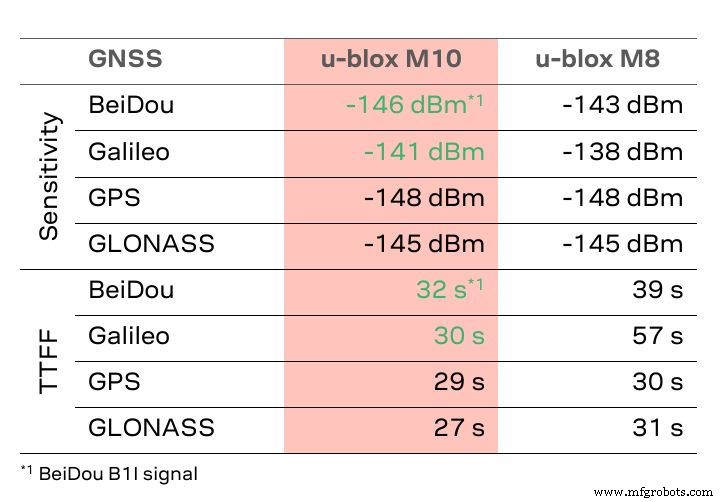
Super‑S also delivers a short time‑to‑first‑fix (TTFF). The chip can acquire a reliable position within seconds, even when using a small antenna or operating in environments with limited sky visibility.
Multi‑Constellation Support
The M10 simultaneously receives signals from up to four GNSS constellations—GPS, GLONASS, Galileo, and BeiDou. In urban canyons or other obstructed settings, the ability to pull in more satellites significantly improves accuracy and reliability.
Galileo’s authenticated navigation messages further strengthen security, providing an encrypted signature that helps verify that signals are genuine and unmodified. This feature is essential for safety‑critical applications such as autonomous driving and advanced driver assistance systems (ADAS).
Hardware Overview
The M10’s 4×4 mm QFN package supports the “MAX” module configuration, eliminating the need for external components. A smaller 20 mm² “ZOE” form factor offers identical functionality in an even more compact footprint.
Figure 1: U‑blox M10 compared to the older M8 (Source: u‑blox)
Performance in Real‑World Tests
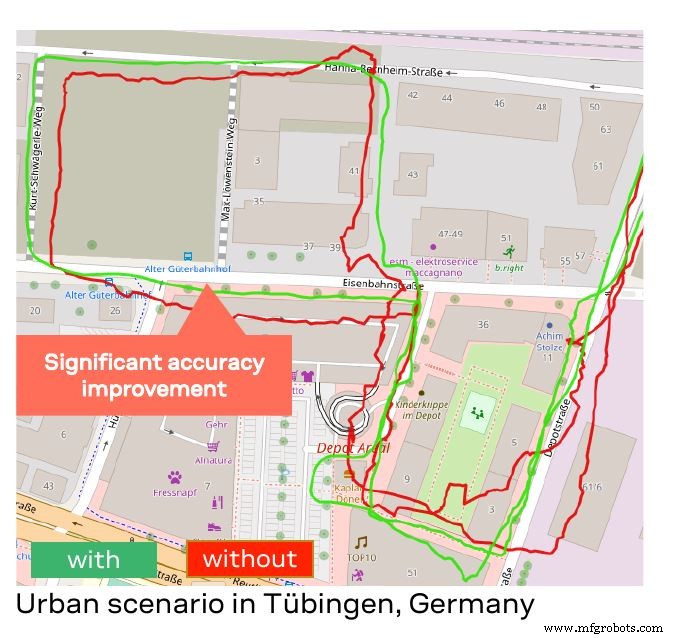
Field tests in Australia and Germany demonstrated that Super‑S and the enhanced Super‑E mode deliver superior performance in harsh conditions. Even when large buildings obscure satellite signals, the M10 maintains high position availability and accuracy.
Drive‑test data show more than a 25% improvement in both position and speed accuracy compared to the M8.
Figure 2: Three module options—QFN, MAX, and ZOE (Source: u‑blox)
Advanced Security Features
The M10 incorporates spoofing and jamming detection. It analyzes raw GNSS data to identify anomalies and can leverage Galileo’s OS‑NMA authenticated signals to mitigate spoofing attacks. Detected threats are reported to the host processor in real time.
Reliability & Protection Levels
Protection level metrics quantify the maximum position error with a given confidence. For example, a 95% protection level of one metre means only a 5% chance that the true position is more than one metre from the reported value.
Why It Matters
As satellite navigation becomes integral to a growing range of applications—from logistics to autonomous vehicles—the need for accurate, secure, and power‑efficient receivers has never been greater. The M10 addresses these demands, offering a small, low‑power solution without compromising on performance or security.
Related Topics
- Thwarting threats to GNSS
- Satellite navigation and Software Defined Radio
- GNSS platform enhances ADAS accuracy
- GNSS correction service enhances position accuracy
- Matching real‑time location technologies to growing tracking needs
- How to get better wireless performance for mobile devices with small PCBs
- Integrating chip antennas into a PCB: Understanding antenna matching
- How adding an antenna changes the design process
- Subscribe to Embedded’s weekly email newsletter
For more Embedded content, subscribe to Embedded’s weekly email newsletter.
Embedded
- Silicon Labs Launches Z‑Wave 700 Series: Extended Range, Ultra‑Low Power, and Rapid Time‑to‑Market
- How to Choose the Right External AC/DC Power Supply for Your Product
- Software‑Driven Power Analysis: Optimizing Semiconductor Design for Efficiency
- Silicon Labs Launches Power‑Efficient Wi‑Fi Modules, Halving Energy Use for IoT Devices
- Renesas Expands Synergy Series with Low‑Power S5D3 MCUs Featuring Advanced Security
- u-blox M9 GNSS Platform Achieves Meter‑Level Accuracy and Advanced Security
- Lattice CrossLink‑NX FPGA: 75% Lower Power, 10× Smaller, 100× More Reliable for Edge AI
- u‑blox F9 GNSS Platform Enhances Xpeng P7 ADAS Precision
- u‑blox Launches SARA‑R5 LTE‑M/NB‑IoT Modules: 5G‑Ready, Ultra‑Secure, Low‑Power for Long‑Term IoT Deployments
- Choosing an Internal AC‑DC Power Supply for Your Product