



Titanium Alloy Heat Treatment: Optimizing Strength, Stability, and Process Control
Titanium Alloy Heat Treatment: Optimizing Strength, Stability, and Process Control
Titanium alloy is prized for its exceptional mechanical properties at both room and elevated temperatures, its outstanding corrosion resistance, and its high strength‑to‑weight ratio. These attributes make it a cornerstone material in aerospace and aviation structures.
Heat Treatment of Titanium Alloy
Adjusting the Microstructure Through Heat Treatment
The microstructure of titanium alloy is largely governed by thermal deformation. Heat treatment primarily serves to fine‑tune the α/β phase balance; it cannot transform a single‑phase β sheet into a dual‑phase structure once it has been formed.
Alloy Phase Composition Limits Strengthening Options
Near‑α and stable β titanium alloys (with the exception of a few special cases such as Ti‑2Cu) cannot be significantly strengthened by heat treatment. Only α+β alloys respond favorably to thermal processing.
Strict Control of Temperature and Time
Heating above the β transformation temperature causes rapid grain growth. Subsequent cooling nucleates α phase at grain boundaries before it intrudes into the grain interior. The resulting β‑phase grain size can become macroscopic, and conventional heat treatment cannot erase this coarse‑grained microstructure; forging deformation is required to refine it.
Thus, when pre‑forging or heat‑treating in the β zone, temperature and dwell time must be tightly regulated to avoid excessive grain growth.
Preventing Embrittlement
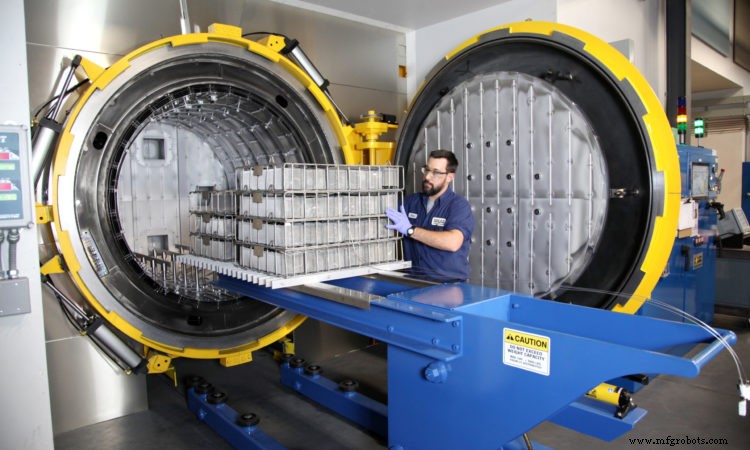
At elevated temperatures titanium alloys readily form surface layers enriched in oxygen or nitrogen, creating an embrittlement layer. Forgings are therefore typically heat‑treated in a micro‑oxidizing atmosphere. Components whose surfaces remain unmachined—such as engine precision‑forged blades—should undergo vacuum heat treatment to eliminate surface oxidation.
Managing Hydrogen Absorption
High‑temperature exposure can cause hydrogen uptake. Using electric furnaces for heating or heat treatment is preferable. If an oil or gas furnace is unavoidable, the furnace gas should be slightly oxidizing to mitigate hydrogen absorption. For critical thin‑walled forgings, chemical milling parameters must be stringently controlled to limit hydrogen uptake.
Controlling Heating and Cooling Rates
Titanium alloys have low thermal conductivity. During cooling, thin sections can cool faster than thick sections, producing an uneven microstructure. Excessive temperature gradients can generate residual stresses that lead to warping or distortion. In the past, ingots with poor formability suffered internal fractures when heated before forging. Segmented heating is recommended to reduce internal thermal stresses.
In summary, the correct and rational use of titanium alloy heat‑treatment processes is essential to prevent failures in titanium components.
Conclusion
We hope this guide has deepened your understanding of titanium alloy heat treatment. For more information on titanium and its alloys, visit Advanced Refractory Metals (ARM), a leading supplier of high‑quality refractory metals worldwide.
Headquartered in Lake Forest, California, ARM is a global manufacturer and supplier of refractory metals, offering titanium, titanium alloys, tungsten, molybdenum, tantalum, rhenium, and zirconium at competitive prices.
Metal
- Titanium‑Alloy Carabiners: Superior Strength and Lightweight for Serious Climbers
- Titanium Heat Exchangers: Superior Performance for Energy and Marine Applications
- Titanium Alloy Investment Casting: Precision, Efficiency, and Material Selection
- Chemical Milling of Titanium Alloys: Process, Benefits, and Best Practices
- Titanium Alloy Forging: Advanced Techniques for Aerospace & Power Generation
- How Titanium Alloys Transform Golf Club Performance
- Titanium Alloy Springs vs. Steel Springs: Performance, Advantages, and Applications
- Titanium Alloy 3D Printing: Applications, Benefits, and Industry Use Cases
- Titanium‑Aluminum Alloys: Advanced Preparation Techniques and Key Industrial Applications
- Titanium Alloys 101: Strength, Grades, and Key Benefits for Engineers