



7 Unexpected Ways Cobalt Shapes Modern Technology

7 Unexpected Ways Cobalt Shapes Modern Technology
Cobalt (Co, atomic #27) is a silver‑gray metal renowned for its high melting point (1495 °C), excellent corrosion resistance, and unique magnetic properties. While many people know it as a component of rechargeable batteries, cobalt’s influence reaches far beyond.
1. Advanced Magnetic Materials
Unlike iron (Curie point 769 °C) or nickel (358 °C), cobalt retains magnetism up to 1150 °C. Magnetic steel that contains 60 % cobalt exhibits a coercive force 2.5× greater than ordinary steel. In vibration‑prone environments, ordinary magnetic steel can lose roughly one‑third of its magnetism, whereas cobalt‑steels lose only 2–3.5 %. These properties make cobalt‑based alloys indispensable for high‑performance magnets in motors, generators, and data storage devices.
2. Hard Alloys and Superalloys for Extreme Conditions
Adding cobalt to tool steel significantly boosts wear resistance and cutting performance. Cobalt‑rich carbides harden the alloy, reduce impact sensitivity, and can extend component life by 3–7×. Stellite alloys containing over 50 % cobalt retain their hardness even when exposed to 1000 °C. At temperatures above 1038 °C, cobalt‑based superalloys outperform conventional materials, making them ideal for aerospace turbine engines, high‑efficiency steam turbines, and modern military hardware. Furthermore, cobalt‑chromium alloys (20–27 % Cr) deliver exceptional oxidation resistance without the need for protective coatings.
3. Battery Technology
Nearly 40 % of global cobalt consumption fuels rechargeable batteries. Lithium‑cobalt oxide (LiCoO₂) forms the positive electrode in most lithium‑ion batteries, offering high energy density and environmental safety. Compared to Ni‑Cd or Ni‑Mn batteries, lithium‑ion variants provide a broader voltage window, higher energy storage, and lower ecological impact.
4. Medical Applications
Cobalt’s role in medicine spans from therapeutic radiation to nutritional supplements. The isotope Co‑60 is widely used for cancer radiotherapy and sterilization of medical equipment. In pharmaceuticals, cobalt is essential to vitamin B₁₂ (cobalamin), where it constitutes about 4.5 % of the molecule’s mass, supporting hematopoiesis. Cobalt alloys are also chosen for artificial joint components and dental fillings due to their biocompatibility and wear resistance.
5. Pigment Production
Cobalt compounds yield some of the most vibrant pigments used in art and industry.
Cobalt Blue (CoO·Al₂O₃)
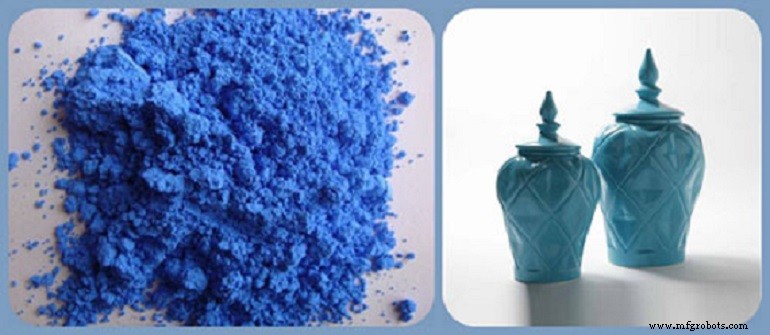
Cobalt blue pigment
With a chemical formula of CoO·Al₂O₃, cobalt blue offers intense hue, weather and acid resistance, and heat stability up to 1200 °C, making it ideal for ceramics, glass, enamel, and high‑temperature coatings.
Cobalt Purple (Co₃(PO₄)₂)
Synthesized via a dry‑solid phase method, cobalt phosphate provides a distinctive blue‑purple shade used in decorative ceramics and glassware.
Cobalt Black
Iron‑cobalt black (Fe,Co)Fe₂O₄ and iron‑cobalt chrome black (Co,Fe)(Fe,Cr)₂O₄ are key metal‑mixed‑phase pigments that color ceramic bodies and glazes, offering durability and a deep, matte finish.
6. Feed Additive for Livestock
Cobalt deficiency in ruminants can lead to reduced digestive efficiency and anemia. Trace amounts of cobalt are routinely added to animal feed to prevent these conditions and support overall herd health.
7. Catalysts and Adhesives
Cobalt compounds serve as effective catalysts in petrochemical refining and as rubber‑tire adhesives, improving performance and longevity in these industrial applications.
Conclusion
We hope this overview sheds light on cobalt’s diverse and often surprising roles in modern technology and industry. For deeper insights into cobalt or other refractory metals, visit Advanced Refractory Metals (ARM).
Headquartered in Lake Forest, California, ARM is a leading global supplier of high‑quality refractory metals—including tungsten, molybdenum, tantalum, rhenium, titanium, and zirconium—at competitive prices.
Metal
- Unexpected Applications of Copper‑Tungsten Alloy
- 4 Surprising Ways Vanadium Powers Modern Industry
- Six Surprising Applications of Zirconium
- 5 Unexpected Ways Titanium Rods Are Used in Modern Industries
- 4 Advanced Rhenium Alloys and Their Key Applications
- Refractory Metals: Properties, History, and Modern Applications
- Round Steel Bars: Key Properties, Applications, and Selection Guide
- Discover 6 Hidden Asset Tag Uses That Boost Efficiency
- Discover Fishbowl: 14 Key Features & Integrations Explained
- Understanding Stamping: The Key Process Behind Coke Can Production