



How Forged Pipe Fittings Are Made: Standards, Materials, and Manufacturing Techniques
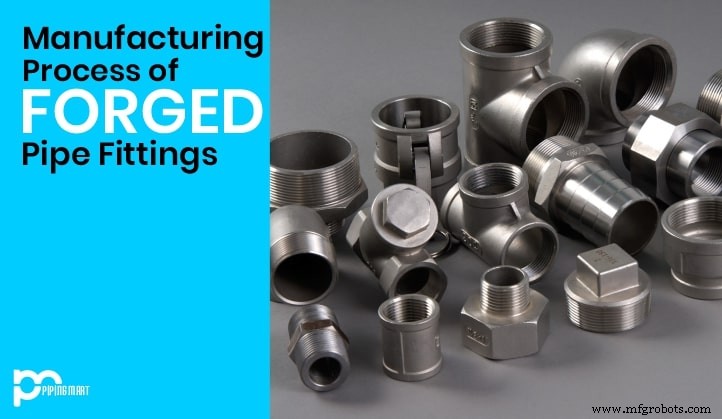
Pipe fittings are essential components in plumbing and industrial piping systems, guiding the flow of liquids and gases while providing connections, changes in direction, and size adjustments. Common types include elbows, tees, reducers, caps, and flanges, each designed to perform specific functions such as connecting sections, altering flow paths, or reducing pipe diameter.
Forged pipe fittings—available in socket‑weld and threaded configurations—adhere to stringent industry standards such as ASME B16.11, MSS SP‑79/83/95/97, and the UK’s BS 3799. These standards ensure dimensional accuracy, pressure integrity, and material quality for nominal bore schedules across a range of applications.
Typical forged fittings are manufactured from high‑strength carbon steel (A105), nickel, or stainless‑steel alloys, providing durability and resistance to corrosion. They are rated for pressure groups ranging from 2000 # to 9000 #, making them suitable for heavy industrial use in petrochemical, power generation, and oil & gas sectors.
Key Manufacturing Processes for Forged Pipe Fittings
- Monaka (Double‑Weld Seam) Method – Two complementary halves of a billet are symmetrically cut, pressed together, and welded, resembling the Japanese confection “Monaka.” This technique is ideal for producing large‑diameter elbows and complex shapes while maintaining structural integrity.
- Hydraulic Bulge (Cold‑Forming) Method – Internal pressure and axial feeding reshape a tube into the desired geometry. Finite‑element analysis and hydraulic bulge tests determine material behavior, ensuring precise control over the final product.
- Hot Forming or Extrusion Method – A hot billet is forced through a die, creating forged pieces with minimal distortion. Variants include forward (overt) and reverse (indirect) extrusion, with lubrication (glass powder for low temperatures, graphite or gasoline for high temperatures) to reduce friction and tooling wear.
- Deep Drawing Method for Caps – Sheet metal blanks are pressed into a die to form circular or irregular caps. The process relies on metal malleability and controlled strain to achieve the desired shape without cracking.
- Flare Method for Stub Ends – Stub ends or lap‑joint flanges are produced by flaring the end of a forged block, followed by machining to precise dimensions. This method ensures a reliable flange face and a strong weld seam.
Each process is chosen based on the required geometry, pressure rating, and material compatibility, ensuring that forged pipe fittings meet the highest standards of performance and safety.
Metal
- How Tungsten Crucibles Are Manufactured
- How Ceramic (Ferrite) Magnets Are Manufactured
- How Modern Magnets Are Made: From Rare‑Earth Mining to Final Magnetization
- Creating Closet Doors with CNC Machines: Precision, Customization, and Efficiency
- The Complete Guide to Pipe Fittings: Types, Functions, and Applications
- Inside the Manufacturing of Electronic Circuits
- How Mechanical Pencils Are Manufactured: A Step-by-Step Guide
- The Complete Guide to Manufacturing Investment Casting Parts
- Inside a Speaker: How They Convert Electricity into Sound and Are Built
- How Microphones Are Made: From Design to Everyday Use