



Carbon‑Fiber Hacksaw: A Lightweight Tool Printed on the Markforged Mark Two
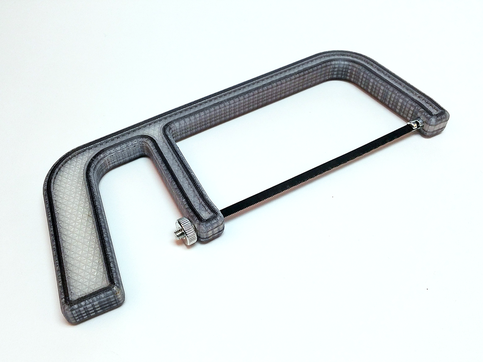
Let’s cut to the chase: the Markforged Mark Two can print carbon‑fiber parts that rival industrial‑grade tools. Here’s a lightweight carbon‑fiber hacksaw that exemplifies the printer’s capabilities.
At Markforged we encourage our engineers to print a new part each week, deepening our understanding of customer needs.
Every Friday, our 'Part of the Week' showcase highlights the best designs.
Last Friday, I presented a fully functional carbon‑fiber hacksaw that I designed and printed on the Mark Two.
My goal was to create a cutting tool that is strong, functional, and lightweight, suitable for diverse applications.
The blade is reinforced with a zebra‑pattern carbon‑fiber lattice, delivering optimal rigidity while keeping weight low.
Unlike Kevlar, which offers some flex, carbon‑fiber provides the strength required for a hacksaw, making it the ideal material.
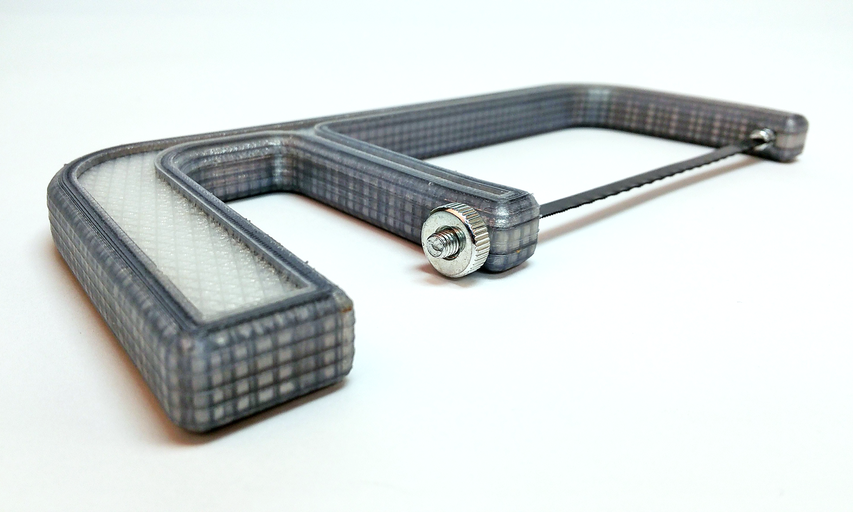
In Eiger, the automatic reinforcement feature satisfies 80% of our customers, but some require finer control over fiber placement and how the Mark Two lays down continuous strands.
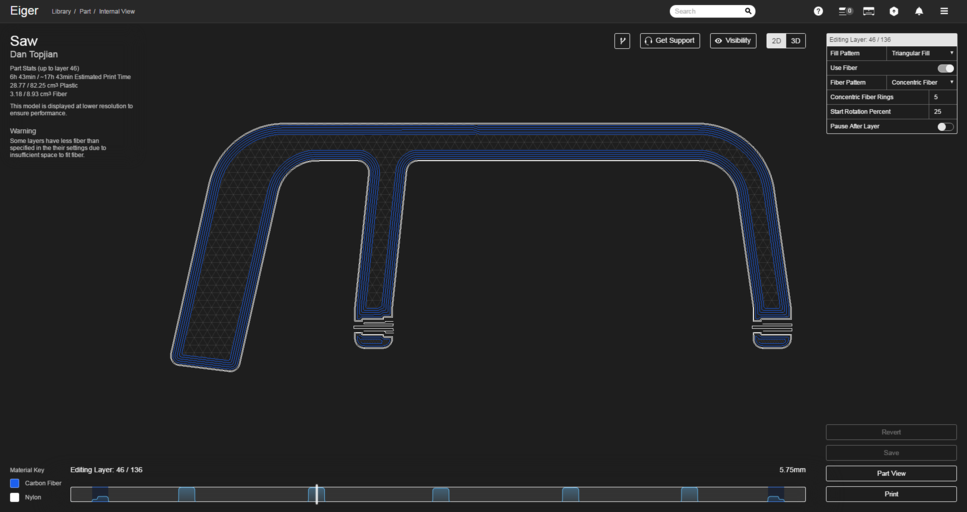
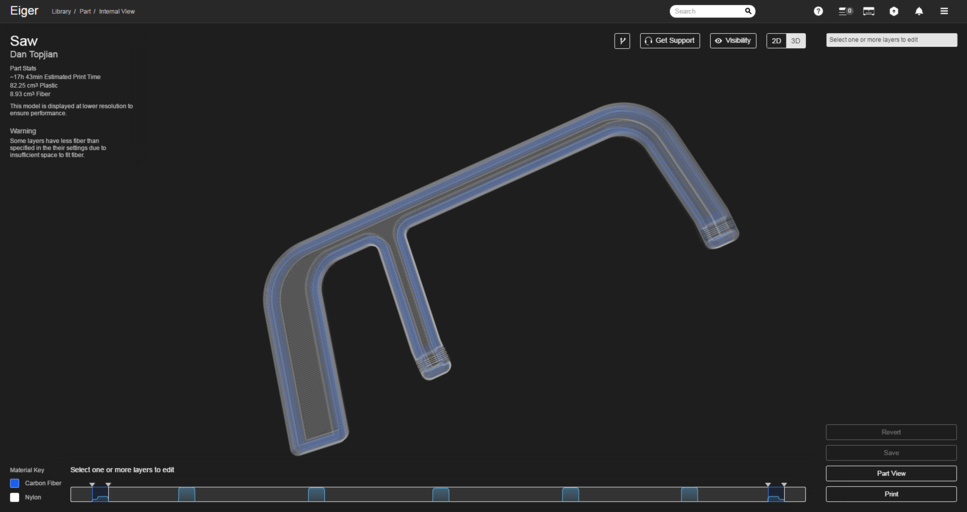
For this hacksaw, continuous fiber strands were laid in a concentric pattern; future iterations will include isotropic layers to reduce torsion during use.
Want to print your own? Download the STL file: Hacksaw.
— Dan Topjian, Senior Application Engineer
Interested in learning more about Eiger and the Mark Two? Request a Demo today!
3D printing
- Effortless Post‑Processing for FDM 3D Prints
- 3D Printing & Prototyping at Mar‑Bal: Accelerating Composite Innovation
- High‑Performance 3D‑Printed Fixtures: Solving Skilled Labor Shortages and Boosting Quality
- Metal 3D Printing Applications: Advanced Use Cases – Part 2
- Metal 3D Printing Applications: Prototyping & Tooling – Part 1
- Understanding the Economics of 3D Printing: ROI & Cost Analysis
- Upgrading the 3DR Iris+ with 3D‑Printed Carbon Fiber Parts – Part 2: Electrical Modifications
- Markforged Elevates Drone Performance with Carbon‑Fiber 3D Printed Parts – Part 1
- Metal 3D Printing Explained: A Three‑Step Process From Design to Finished Part
- 3D Printing Explained: Part 1 – From Raw Materials to Modern Innovations