Industrial manufacturing
Industrial Technology


What Is EDM and Is It Right for 2-Axis Metal Cutoff? Electrical discharge machining, or the EDM wire cutting process, uses controlled and rapidly repeating electrical charges to remove material from electrically conductive materials such as metals. Many people look at wire EDM cutting in
Things to Know and Factors to Consider As a company that does a significant amount of work with specialty metals, Metal Cutting Corporation often employs eddy current testing (ECT) to inspect materials for defects such as cracks or voids. This method utilizes electromagnetic induction to detect
What ECT Can Find vs. What It Cannot In a related article, we touched on some interesting facts about the eddy current testing procedure. This time, we’ll take a closer look at some of the variables that have an effect on eddy current testing (ECT), what it can find, and
Some Pros and Cons to Consider About Titanium Tubing Because we at Metal Cutting are specialists in precision cut-to-length metal tube, people often pick our brains to learn more about the advantages or disadvantages of different tubing materials. Titanium tube is an interesting topic bec
Is Precision Parts Manufacturing 3D Print-Ready? The topic of 3D additive laser printing of metal is frequently in the news. So you might wonder: When is Metal Cutting Corporation going to talk about laser printing? After all, we often talk about various other methods for making me
Does the abrasive waterjet method make sense for 2-axis metal cutoff? Modern waterjet cutting has its roots in using water (although at comparatively low pressure) to cut soft materials such as paper and food, going back to the 1930s. Thanks to the evolution of high-pressure technology and equip
Is a cold saw a good choice for your metal cutoff application? Before you choose cold sawing for your 2-axis metal part cutoff, it is critical to understand the advantages and disadvantages of the process. That way, you can evaluate and decide whether it — or any other precision metal cutting me
How to Balance Rough and Smooth in Orthopedic and Dental Implants The development of 3D printing technology has had a revolutionary impact on the medical device industry, opening up unlimited new possibilities in product design and mass customization. However, there is an interesting twist — the
The Myths of Plastic vs. Metal Tubing for Medical Devices As medical technology advances and new minimally invasive procedures are developed, medical device designers must come up with medical tubing products that are: Ever smaller in diameter More sophisticated and yet still cost-effect
What are “precision metals”? In the world of metal machining, people are often looking for what they call precision metals. But what exactly does that mean? Depending on the application, the term precision can pertain to a number of characteristics: The precision of a
Our name might not give it away, but precision cut off is at the core of our business. Allow us to let you in on a little secret: Our company has had the wrong name for years and years. Don’t get us wrong. We have the capabilities to do what is truly metal cutting, which is machining along with
How to Pick Your Partner and Get the Results You Need As an expert in producing small cut off metal parts, Metal Cutting Corporation specializes in meeting the tight tolerance requirements of customers across applications ranging from automotive parts and electronics to medical devices and biotec
The answer is not as simple as you’d think! At Metal Cutting Corporation, we often have people come to us and ask if we do metal fabrication. The truth is, the answer depends on how you define the term. While we don’t consider ourselves a “fabrication company,” we do a lot of fabrication in the s
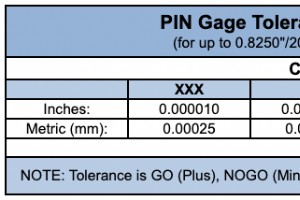
The Practicality of Pin Gages for Tube ID Inspection Here at Metal Cutting Corporation, for many applications it is not enough for us to create parts to a customer’s specified tolerances. A big part of our quality control is to also make sure we can measure parts effectively and provide proof po
How to Minimize the Effects of Heat on the Measurement of Metal Parts At the height of summer here at Metal Cutting Corporation, our thoughts naturally turn to the weather and the ways in which heat can affect: The materials our customers chooseThe tools used to measure the tight tolerance, s
Why Include Heat Treatment of Metal in Cut-Off Parts Specifications? We’ve talked elsewhere about how heat expansion may be a factor when deciding how precise the dimensions of a metal part need to be. Namely, if even a slight difference in tolerance caused by heat expansion would affect how t
Are Visual or Mechanical Inspections Ever Truly 100%? Metal inspection is a critical step in the manufacturing process, helping to ensure the quality of small metal parts that are the components of (literally) countless products. Yet, the concept of 100% inspection of parts is a somewhat tricky
Flatness vs. Parallelism and Other Criteria For metal cut to length, which is a crucial activity of our business, dimensional issues are key. Making sure that we understand our customers’ needs up front, and that we are speaking in terminology that aligns with what the customer is saying, is par
Science Opens Up Alternatives to Stainless Steel Stainless steel in its different varieties — including 304, 316, and 316L, among others — is the material that forms the backbone of the medical device industry. However, other metals are important and are becoming even more so. That’s because
In the machining world, turning tools such as lathes and mills are the flashy stars. In fact, they are machining to most people. However, the ability to do precision centerless grinding in addition to machining is a definite advantage. How does centerl
Industrial Technology