



Snowshoe: History, Design, and Modern Innovations
Background
Snowshoes lift you above the snow, preventing sinking into soft drifts and opening up terrains that ordinary boots cannot traverse. Though their roots stretch back thousands of years, modern snowshoes—often made from lightweight aluminum alloys and engineered polymers—offer unmatched performance with minimal maintenance.
History
First crafted in Central Asia around 4000 B.C., snowshoes were likely carried across the Bering Land Bridge by early peoples. Native North Americans perfected a variety of designs—paddle‑shaped Huron models, front‑pointed Ojibwa shoes, up‑turned‑toe Athabascan styles, and robust Algonquin frames—each tailored to specific landscapes.
European fur traders adopted these tools in the St. Lawrence Valley, while English settlers initially rejected them, paying a steep price during the French and Indian War when British troops were outmaneuvered by foes equipped with snowshoes. The tactic became standard winter gear for British forces and spread westward with expanding settlements.
Recreational snowshoeing dates back to the late 18th‑century Quebec clubs, where participants raced over long distances, short sprints, and even hurdle jumps. In 1871, the Montreal Snowshoe Club set a minimum weight of 1.5 lb (0.68 kg) to ensure durable performance. By the 1920s, snowshoeing had become a social pastime in Eastern Canada and the U.S.
Interest waned until the 1950s, when manufacturers experimented with magnesium, steel cable, aluminum, and Lexan (polycarbonate). These materials eliminated the upkeep of wood‑and‑rawhide pairs—no varnishing or waxing needed—spurring a new generation of enthusiasts.
Raw Materials
Traditional snowshoes still feature ash frames and rawhide webbing—historically sourced from moose, deer, or caribou. Today, cow hide or even water buffalo hide is used for stronger, more economical options. Modern frames are predominantly aluminum alloys, sometimes coated with powdered plastic or graphite for extra lightness. Decks and bindings are usually neoprene, polyurethane, or nylon‑coated composites.
The Manufacturing Process
Traditional Wooden Snowshoes
- High‑grade ash is inspected, steamed to soften, and bent into shape. Drying in a kiln takes 2–7 days.
- Frames are sanded, coated, and drilled for lacing. Two crosspieces are inserted.
- Skilled workers weave rawhide lacing on site; a single lacer can finish up to ten pairs daily.
- Bindings are affixed, followed by final inspection, drying, and packaging.
Aluminum Snowshoes
- Seamless aluminum tubing is inspected and bent in a custom machine—either manually or hydraulically—into the precise frame shape.
- Frames may be powder‑coated to protect against abrasion.
- The deck, cut from a continuous roll of neoprene or polyurethane, is die‑stamped and imprinted with the brand logo.
- Deck and frame are riveted together; cleats, bindings, and pivot straps are added in a final assembly step.
- Finished shoes undergo visual quality checks before boxing.
Quality Control
Every raw material undergoes inspection upon arrival. Throughout the process, workers perform visual checks; any miscut deck or misaligned frame is immediately flagged. Small‑scale manufacturers rely on hands‑on scrutiny rather than automated lines, ensuring each pair meets rigorous standards. Feedback from seasoned users is incorporated quickly, allowing rapid design refinement.
The Future
While “modern” snowshoes have been around for half a century, the sport’s popularity in the 1990s sparked expanded marketing, new trail networks, and a broader consumer base—including women and children. Upcoming trends focus on vibrant colors and ergonomic designs, though the core function remains unchanged: reliable, lightweight travel over snow.
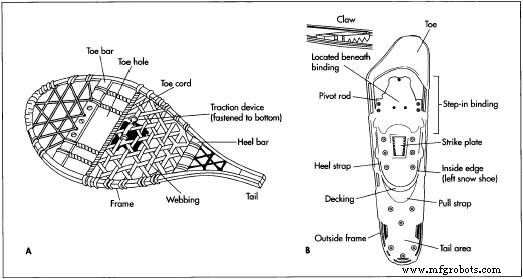
A. Traditional snowshoe. B. Aluminum snowshoe.
Manufacturing process
- What is VMC Machining? An Expert Overview of Vertical Machining Centers
- Expert Guide to Aluminum Laser Marking: Precision, Durability, and Industry Applications
- MIG vs. TIG Welding: Selecting the Right Arc Welding Technique for Your Project
- Comprehensive Guide to Laser Marking: Types, Benefits, and Applications
- Key Considerations for High‑Volume Swiss Machining
- CNC Prototyping Guide: Precision, Speed, and Cost‑Effective Production
- Expert Shaft Manufacturing: Precision Processes & Custom Solutions
- Fiber Laser Marking: Precision, Speed, and Versatility for Modern Industries
- Electropolishing vs. Passivation: Choosing the Right Stainless Steel Finishing
- Snowshoe: History, Design, and Modern Innovations