Industrial manufacturing
Manufacturing process


Refractory lining of a Basic Oxygen FurnaceThe purpose of a refractory lining in a basic oxygen furnace (BOF) is to provide maximum furnace availability during operation of the converter in order to meet production requirements and to ensure lowest possible specific refractory consumption. For achie
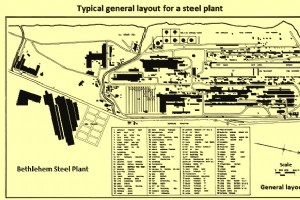
Systematic Planning of General Layout of a Steel PlantDesigning of general layout of the steel plant consists of a mechanism which involves knowledge of the space requirements for the facilities and also involves their proper arrangement so that continuous and steady movement of the production cycle
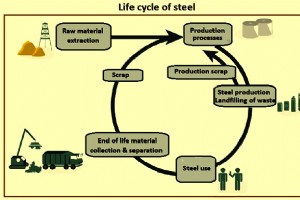
Life cycle assessment and steel sustainability The steel industry is the second largest industry in the world after oil and gas industry. Steel is used in almost every sector which ranges from building and construction, packaging, transportation industry, and power and renewable energy sector. Use o
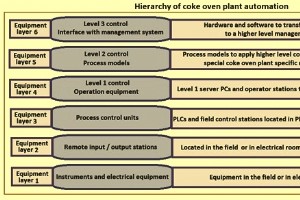
Automation, Control, and Measurement System of Coke Oven PlantMetallurgical coke is used in iron and steel industry processes (primarily in blast furnaces) for the reduction of e iron ore to iron and in foundries. Over 90 % of the total coke production is dedicated to blast furnace operations. Found
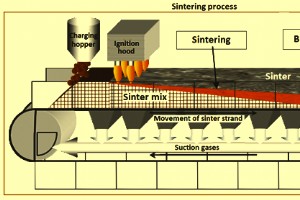
Automation and Control System of Sinter PlantSintering process (Fig 1) is a metallurgical process carried out on a sintering machine. It is a thermal agglomeration process. The sintering process is an energy intensive process, in which a number of parameters have to be taken into account. The proce

Green SteelmakingThe average annual temperature of the earth is rising since the industrial revolution. This is mainly due to the burning of the fossil fuels which increase the emissions of carbon di-oxide (CO2) in the atmosphere. Prior to the industrial revolution, 280 ppm (0.028 %) of the atmosphe
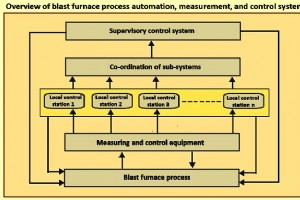
Blast Furnace Process Automation, Measurement, and Control SystemThe efficient operation of the modern blast furnace needs a high degree of automation in conjunction with a measuring system and a monitoring and control system. The blast furnace process control system in combination with the blast fu
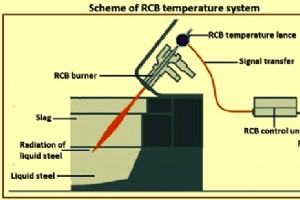
Automation Control and Modelling of Electric Arc FurnaceThe electric arc furnace (EAF) constitutes the main process in scrap / DRI (direct reduced iron) based steelmaking and the second most important steelmaking process route in terms of global steel production. It is the main process for recycling
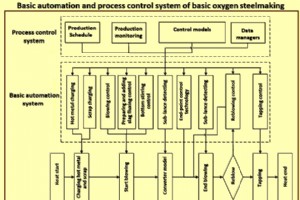
Automation, Control and Modelling of Basic Oxygen SteelmakingIn the basic oxygen steelmaking process, the basic oxygen furnace or converter produces liquid steel by reducing the carbon content of hot metal made by the blast furnace from around 4.5 % to 0.03 % to 1.0 %. The converter blows large amou
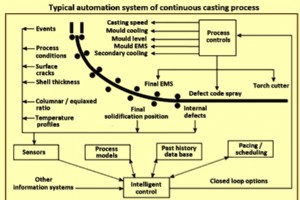
Automation, Instrumentation and Modelling of Continuous Casting of SteelContinuous casting process for liquid steel is a process whereby the liquid steel is solidified into a semi-finished steel product (billet, bloom, beam- blank, round, or slab) for subsequent rolling in the rolling mills. The bas
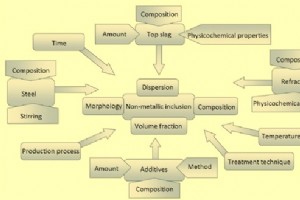
Inclusions, Inclusion Engineering and Clean SteelsInclusions are non-metallic compounds and precipitates which form in steel during its production and processing and hence are the by-products of steelmaking which arise from different chemistries and processes. Inclusions can vary widely in size and
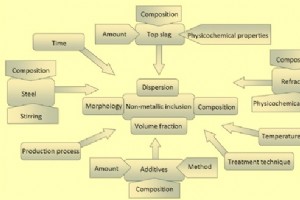
Inclusions in Steel and Secondary Steelmaking Non-metallic inclusions, (hereinafter referred to as ‘inclusions’), are chemical compounds consisting of at least one non-metallic component, such as sulphur or oxygen. In steels, inclusions are an unwanted but mainly an unavoidable phase caused by the c
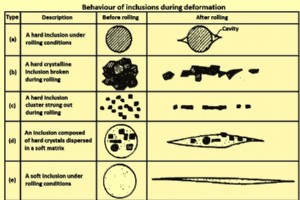
Inclusions in Continuous Cast Steel and their Detection Continuous casting of steel is an important process for the production of steel worldwide, owing to its inherent advantages of energy saving, high yield, flexibility of operation, and competitive quality of the cast product. With the establishm
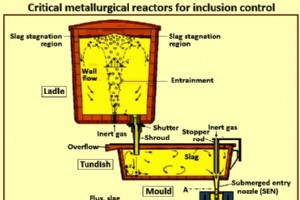
Effect of Inclusions on the Properties of SteelSteel is a versatile material which is having very wide applications. It is of interest for several applications because of its several advantages such as high strength to weight ratio, durability, versatility, recyclability, and most importantly its ec
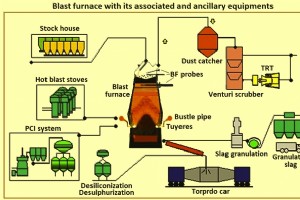
Important aspects of design of Blast Furnace and associated ancillary equipmentsThe design of the blast furnace (BF) proper and its associated and ancillary equipments (Fig 1) immediately upstream and downstream of the furnace is important for the efficient running of the BF. Besides the furnace pro
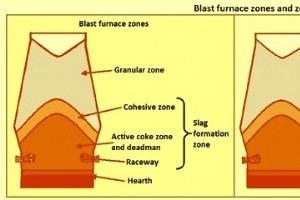
Blast Furnace Slag and its Role in Furnace OperationThe importance of blast furnace (BF) slag in achieving smooth operation of the BF is illustrated by the old saying ‘if you take care of the slag, the furnace will take care of the rest’. There has been a tremendous quantity of work has been done on

Lean manufacturing has become a common methodology implemented by countless manufacturing companies, both in the United States and abroad. It refers to the use of a manufacturing system that minimizes waste and maximizes efficiency. The concept of lean manufacturing was originally pion

A rivet is a type of fastener that’s used in the permanent assembly of a product or workpiece. Featuring a bolt-like design, they are affixed with a head that’s wider than the shaft. When a rivet is driven into a product or workpiece, its shaft — also known as a tail
When shopping for workholding solutions, you may come across jig feet buttons. They are commonly used as workholding solutions in the manufacturing industry. Overview of Jig Feet Buttons Also known as jig rest buttons, jig feet buttons are workholding solutions that are desi
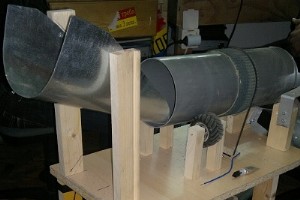
This machine was created as a student project for the subject Construction & CAD, at the Mechanical Engineering faculty in Skopje, by a team of five students.It is a machine that is sorting two types of plates. One of the plates have holes and the other ones don’t
Manufacturing process