


Industrial manufacturing
3D printing
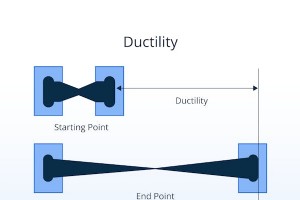
Ductile failure is a critical consideration in the design of components subjected to tensile loading. Engineers typically design parts so that the expected maximum stress remains within the elastic limit of the material—below its yield point—to avoid permanent deformation. However, if stress exceeds
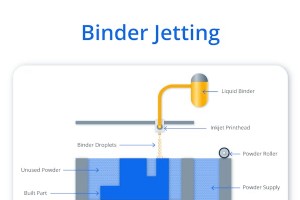
Binder jetting and material jetting are two related 3D printing technologies that, on the surface, have similarities. On closer examination, the differences are much greater. Binder jetting is a material-adaptable, powder-bed process. Model slices are bonded and keyed to the slice below by jetting a

Onshape® is a cloud-based 3D CAD platform with a wide range of features for mechanical and product design. Because most processing is performed in the cloud, it does not require high-performance local computer hardware. Onshape does not include native finite element analysis (FEA) or rendering tools

Fused Deposition Modeling (FDM) is a term originally trademarked by Stratasys that refers to a 3D printing technology known as Fused Filament Fabrication (FFF) that builds objects by extruding thermoplastic filament layer by layer from digital design data. Fused Deposition Modeling plays a central r
PET 3D printing filament is a durable and versatile material used in additive manufacturing. The 3D printing filament is made from polyethylene terephthalate, a type of thermoplastic polymer known for its strength, flexibility, and recyclability. Polyethylene terephthalate (PET) filament has excelle
CategoryMaterial TypePLA (Polylactic Acid)Bio-based thermoplastic derived from renewable sources (corn starch or sugarcane).PETG (Polyethylene Terephthalate Glycol)Petroleum-based thermoplastic modified for improved ductility and chemical resistance.CategoryEase of PrintingPLA (Polylactic Acid)Suita
Converting a Standard Triangle Language (STL) file to the Standard for the Exchange of Product (STEP) format transforms a mesh‑based model into a solid, feature‑based representation suitable for engineering workflows. The process begins with importing the STL mesh into conversion software that recon
Bulk modulus is a measure of a material’s resistance to uniform compression. It describes how much a material decreases in volume when pressure is applied equally in all directions. This property is relevant to gases, liquids, and solids, and it helps assess how materials behave under hydrostatic or
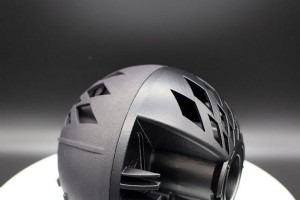
To smooth 3D prints, achieving a high-quality finish is essential for aesthetic appeal and functionality. A smooth surface increases visual appeal by minimizing visible layer lines and providing a more refined finish. The process makes the print more suitable for subsequent post-processing. Smoothin
A Standard for the Exchange of Product (STEP) file represents a neutral Computer-Aided Design (CAD) format defined under the ISO 10303 standard, and the structure preserves solid geometry, surface data, and organized assemblies for engineering and manufacturing workflows. A STEP file facilitates rel
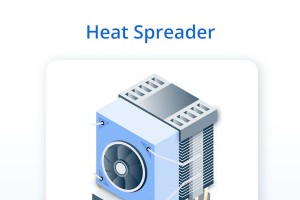
Heat spreaders are objects made of materials with high thermal conductivity that either spread heat from a localized source across a larger surface area, sometimes transferring it to a secondary heat exchanger, heatsink, or dissipating it into ambient air to prevent the overheating of critical compo
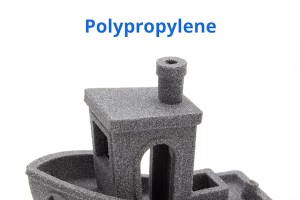
PP (Polypropylene) is a semicrystalline thermoplastic. It is the second most commonly used commodity plastic after polyethylene. It is primarily used in packaging for food and consumer goods, due to its favorable balance of properties and low cost. PP was first synthesized in 1951 by J. Paul Hogan a
Ductility is a materials ability to undergo significant plastic deformation before fracturing when subjected to tensile stress. Engineers use standardized tests to quantify this characteristic. In these tests, a gradually increasing tensile force is applied to the specimen until it fractures or reac
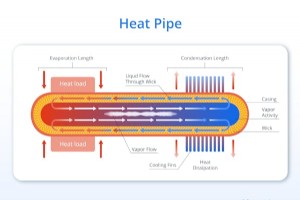
Heat pipes are passive devices used to transfer heat in closed-loop systems and are commonly found in heat recovery units, spacecraft thermal control, and electronics cooling. A heat pipe transfers heat by harnessing phase change and capillary action within a sealed, evacuated tube containing a wick
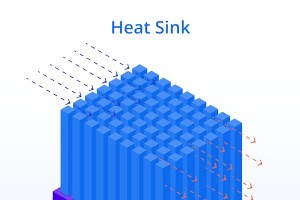
A heat sink is a device used to transfer heat from a heat source to the surrounding environment. Heat transfer is achieved through a combination of conduction, convection, and, to a lesser extent, radiation. A heat sink typically has a base with multiple fins on top, designed to increase the surface
Slicer software is a foundational component in the Fused Deposition Modeling (FDM) 3D printing process, serving as the intermediary between a CAD model and the printer hardware. Without it, a 3D printer cannot interpret or fabricate a design. The slicer translates 3D geometry, typically exported as
The nine most common 3D printing file types form the foundation of digital manufacturing because each format delivers a distinct structure that supports modeling, slicing, or production preparation. Each 3D printing file format (STL, OBJ, AMF, 3MF, STEP, IGES, SLDPRT, PLY, and VRML) carries characte
STL to 3D Printer describes the foundational process that converts STL files into physical objects through additive manufacturing. STL files function as geometric blueprints that define exterior surfaces through triangular facets, creating a mesh suited for slicing into layers. STL lacks parametric

Without knowing how a material reacts to tension, or how much of it it can take, your engineered products and structures can fail and leave you scratching your head. A great way to avoid this is via a stress-strain curve graph that provides a visual explainer of a material’s qualities and how it wil
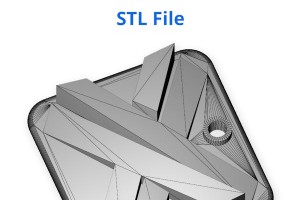
Both STL and OBJ files are widely used formats in the field of 3D printing and modeling, and each has specific functions and applications. STL (standard tessellation language), the most common, is highly compatible and straightforward when it comes to describing three-dimensional objects with a tri
3D printing
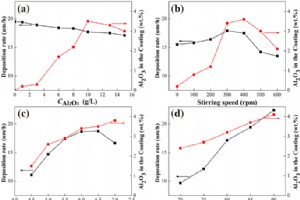
Enhancing Magnesium Alloy Performance: Electroless Ni‑P‑Al₂O₃ Composite Coatings—Deposition, Properties, and Service Life
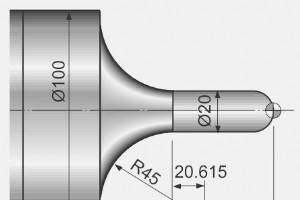
CNC Circular Interpolation Tutorial: Master G02 & G03 G‑Codes
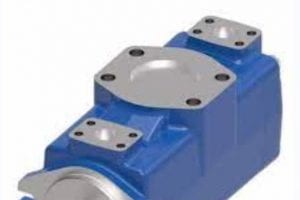
Top 5 Reasons to Choose the Vickers VQA2 Vane Pump for Industrial Applications
Proven Strategies for Efficient CAD Model and 3D File Management

