Industrial manufacturing
3D printing

Printers of the FDM/FFF (Filament Deposition Modeling/Fused Filament Fabrication) variety build parts using strands of plastic feedstock known as filaments. The plastic is melted and extruded to build the 3D model. There are several types of 3D printer filaments that are known for their strength and
Direct energy deposition (DED), also referred to as directed energy deposition, is a particular approach to additive manufacturing (3D printing). It directs an energy source at a spot on the source material to make a small amount of melt and then adds feed material to this melt in order to deposit n
MJF, which is an abbreviation for multi-jet fusion, is a much-beloved type of 3D printing that comes packed with some pretty impressive benefits, like the fact its parts can be up to 98% isotropic, the powder is reusable (up to 80% of unused material), it’s fast, and its parts are very detailed. MJF
In the context of 3D printing, extrusion is the process whereby a semi-liquified slurry or paste is squeezed through an orifice or die to make a cylindrical (or other) shaped line of the material. It then hardens or cures, allowing a new layer of extruded material to be laid on top. Both fused depos

DLP (Digital Light Processing) and LCD (Liquid Crystal Display) printers are resin-based (or vat-polymerization) 3D printing technologies. Both processes work thanks to a photosensitive resin that is stored in a tank and cured by a light source. This light source is used to solidify the resin. It cr

SLM (Selective Laser Melting) and EBM (Electron Beam Melting) are powder bed-fusion 3D printing technologies. A high-energy beam is used to fuse metal powder layer by layer to ultimately print a solid component. SLM has better accuracy and resolution than EBM. EBM, on the other hand, can print faste

When was DMLS Technology Invented?Direct Metal Laser Sintering (DMLS) technology was invented in 1995 when a German company called EOS (Electro Optical Systems) first commercialized it. EOS owns the DMLS trademark.Direct Metal Laser Sintering (DMLS) is used for the serial manufacture of complex indu
ABS, which stands for acrylonitrile butadiene styrene, is one of the most commonly used 3D printing filaments. It’s used to create plastic parts that have to be strong and hold their own in temperature changes. Let’s go over its composition, uses, and properties, as well as how it fares when compare
3D printing slicer software converts 3D models into printer instructions. These instructions tell the printer head where to go, how to move there, and what to do when it arrives. A slicer software “slices” digital models into layers to be printed, plus controls print parameters. It is generally inst

What is Flex 3D Printing?Flex 3D printing is the term used to describe 3D printing processes that use flexible filaments made from TPEs to create parts layer-by-layer. Several different types of flexible filaments can be used in 3D printing with each type coming with its own advantages and disadvan

What is 3D Printing?3D printing is an additive manufacturing technology used to produce parts out of a wide range of plastics and metals. There are many different technologies available, from FDM (Fused Deposition Modeling) which extrudes plastic one layer at a time, to DMLS (Direct Metal Laser Sint

The aerospace industry is at the forefront of technological innovation, continually seeking new methods to enhance productivity, reduce costs, and improve performance. In recent years, 3D printing (also known as additive manufacturing) has begun to transform aerospace manufacturing, particularly in
Engineers, designers, and manufacturers work with a lot of different file types, and one of the most common you’ll become familiar with if you’re part of the 3D printing world is an SLDPRT file. These contain worlds of information that help create a 3D model of a part and will be converted into anot
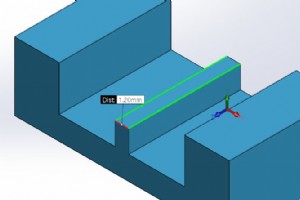
Fused Deposition Modeling (FDM) is an additive manufacturing process in which a machine precisely extrudes melted plastic filament to create a part. The filament is extruded out of a heated end, laying down in a zig-zag pattern to create the shape of the part from the bottom to the top. FDM technolo
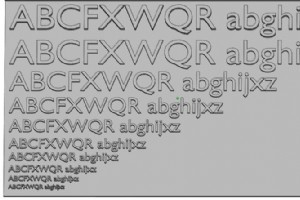
Words are great, and they look even better when they’re fully resolved on your 3D printed part!As with all additively manufactured parts, it is important to design for the desired 3D printing process. We hope that our text test answers any open questions:Text adheres to the same 0.6mm wall and gap r
When you’re 3D printing, whether for mass production or prototyping, the software you use is arguably the most important factor in the whole process and can make or break your project. Two of the most common 3D software options are FreeCAD and Fusion 360, which we’ll look at in more detail in this a

The DXF (Drawing Interchange(X) Format) is among the most common formats for CAD and CAM packages. While it can represent 3D wireframes, the format is predominantly used for 2D applications in practice. Its main role is serving as an interoperability tool to share models and drawings across incompat

1. Stainless SteelStainless steel is widely known for its ability to withstand corrosion, high strength, and excellent aesthetic appearance. Parts printed with stainless steel can have the same or even greater strength than parts created using traditional manufacturing methods. The strength, hardnes
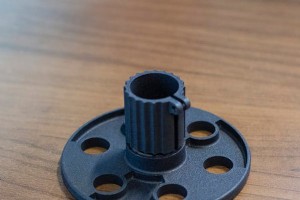
3D printing, or additive manufacturing, is a process in which 3D models are constructed from a CAD or digital 3D model. During the process, the material is deposited layer-by-layer to form the desired object. Traditional manufacturing processes, by contrast, refers to established manufacturing techn

When an outside force is applied in a way that compresses or squeezes an object, it causes a type of stress called compressive stress. Compressive stress forces the atoms in a material to try to move closer together than the crystal structure and interatomic forces allow. The atoms slip past each ot
3D printing