



Understanding Instantaneous Values in Pure AC Resistor Circuits
Instantaneous Values in AC Circuits
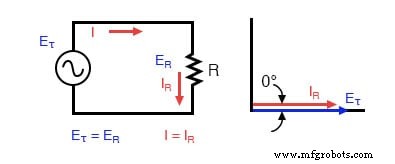
Pure resistive AC circuit: resistor voltage and current are in phase.
When a single AC source drives a resistor, the voltage and current waveforms trace out identical sinusoidal curves. The figure above shows the source voltage and the current that flows through the resistor.
Because a resistor offers a constant opposition to current flow, the voltage drop across it follows the same instantaneous values as the current. At any instant, the voltage and current share the same sign and magnitude—this is the definition of being “in phase.”
For any point along the horizontal axis, the instantaneous voltage and current satisfy Ohm’s law exactly: V(t) = I(t)×R. This holds true for every moment, not only on average.
We can also compute the instantaneous power delivered to the resistor. By multiplying V(t) by I(t), we obtain a waveform that is always positive, reflecting the fact that a resistor dissipates energy rather than storing it.
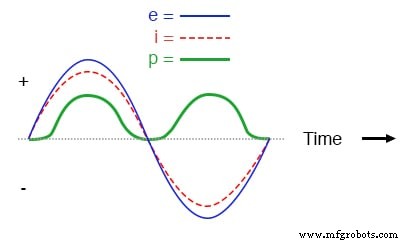
Instantaneous AC power in a pure resistive circuit is always positive.
These relationships form the basis for AC circuit analysis and are consistently described in standard texts such as “Fundamentals of Electric Circuits” by Alexander & Sadiku.
RELATED WORKSHEETS:
- Inductive Reactance Worksheet
Industrial Technology
- Building Resistor Circuits: From Alligator Clips to PCBs
- Current Divider Circuits: Theory, Formula, and Practical Applications
- Building Series‑Parallel Resistor Circuits: From Breadboards to Terminal Strips
- Understanding AC Inductor Circuits: Reactance, Phase Shift, and Power Dynamics
- Analyzing Series Resistor‑Inductor AC Circuits: Impedance, Phase, and SPICE Verification
- Pure Resistive AC Circuits: Voltage and Current In Phase
- AC Capacitor Circuits: Capacitive Reactance, Phase Shift, and Power Behavior
- Series RC Circuit Analysis: Impedance, Phase Relationships, and SPICE Validation
- Millman’s Theorem: Step‑by‑Step AC & DC Circuit Analysis with Practical Examples
- How Current Limiting Circuits Protect Electronics & Power Supplies