



Powder Metallurgy: From Powder Production to Final Products – A Comprehensive Process Overview
Powder Metallurgy: From Powder Production to Final Products – A Comprehensive Process Overview
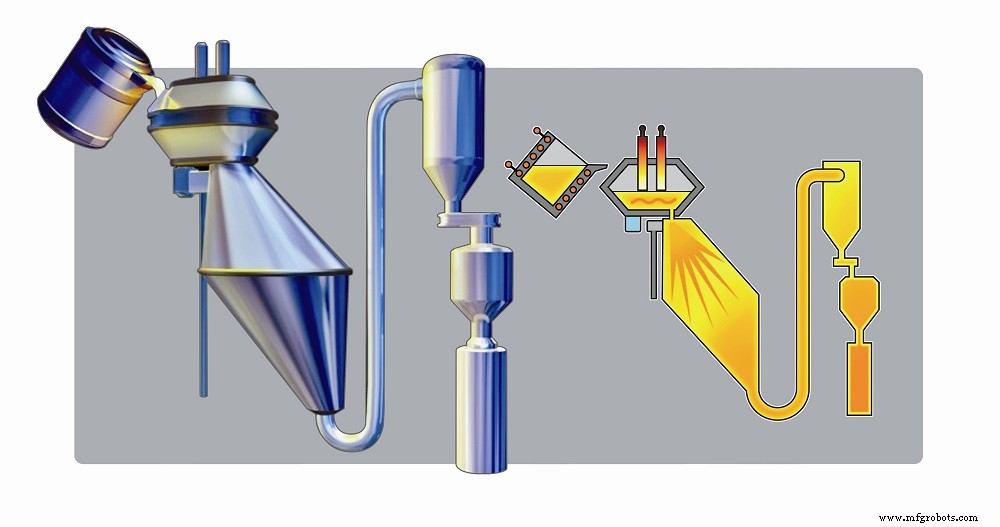
Powder metallurgy is a precision manufacturing method that transforms metal powders into complex components through controlled forming, sintering, and finishing operations. Below is a detailed walk‑through of each step, highlighting the technical nuances that give powder‑metallurgy parts their unique performance advantages.
The Core Steps of Powder Metallurgy
- Raw‑Material Powder Preparation
Powder can be produced by mechanical routes—such as crushing or atomization—or by physical‑chemical routes—electrochemical corrosion, reduction, vapor deposition, and more. The industry favours reduction, atomization, and electrolysis due to their scalability and consistent particle size control. - Mixing
Blending powders in precise ratios ensures uniform composition. Depending on the application, manufacturers use dry, semi‑dry, or wet mixing to achieve homogeneity and prevent segregation. - Billet Formation
The mixed powder is compacted into billets using pressure forming (e.g., isostatic pressing) or pressure‑less methods (e.g., extrusion). This step sets the component’s geometry and initial density. - Sintering
Sintering consolidates the billet by heating it below the melting point of the alloy. Choices include unit sintering, multi‑component sintering, or liquid‑phase sintering, depending on the desired microstructure. Advanced techniques such as hot pressing or inert‑gas sintering further refine density and strength. - Post‑Processing
After sintering, parts may undergo machining, heat treatment, surface finishing, or electroplating to meet dimensional tolerances, surface integrity, and functional requirements.
Powder metallurgy spans a vast array of industries—from precision tools and aerospace components to cutting‑edge electronic devices—demonstrating its versatility and high performance.
Conclusion
Understanding the powder‑metallurgy chain—from raw‑material synthesis to final finishing—equips engineers and manufacturers with the knowledge to design robust, high‑quality metal components. For deeper insights into refractory powders and alloys, consider visiting Advanced Refractory Metals (ARM), a global leader in tungsten, molybdenum, tantalum, and other high‑temperature materials.
Metal
- Refractory Metals & Alloys: Essential High‑Temperature Materials for Aerospace
- Titanium and Alloy Anodizing: Process, Coloration, and Applications
- Refractory Metals: Key Properties and Industrial Applications
- Abundant Refractory Metals: Properties, Applications, and Emerging Technologies
- What Are Refractory Metals? An Expert Overview of Their Properties and Applications
- Refractory Alloy Sintering Process – Six Key Stages & Influencing Factors
- Sintering of Refractory Metal Powders: Processes, Classifications, and Performance Outcomes
- Powder Metallurgy Explained: Definition, Processes, and Benefits
- Powder Metallurgy: Process, Benefits, and Drawbacks
- Powder Metallurgy: Definition, Process, and Benefits