



Building an Enabled NAND‑Gate SR Latch: Parts, Design, and Operation
Components and Materials
- 4011 quad NAND gate (Radio Shack catalog # 276-2411)
- Eight‑position DIP switch (Radio Shack catalog # 275-1301)
- Ten‑segment bar graph LED (Radio Shack catalog # 276-081)
- 1 × 6 V battery
- 3 × 10 kΩ resistors
- 2 × 470 Ω resistors
Important Note: The 4011 IC is CMOS and highly sensitive to static discharge.
Cross‑References
Lessons In Electric Circuits, Volume 4, Chapter 3: “Logic Gates”
Lessons In Electric Circuits, Volume 4, Chapter 10: “Multivibrators”
Learning Objective
Understand how an enabled latch functions and how to implement it using NAND gates.
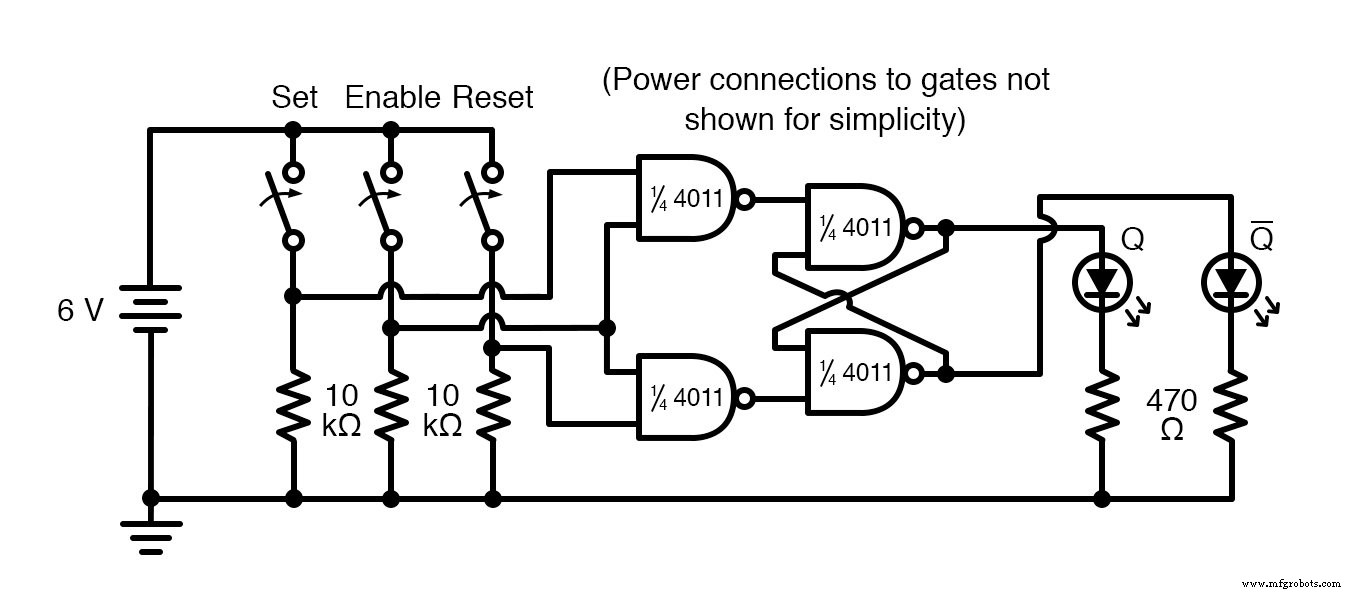
Schematic Diagram
Illustration
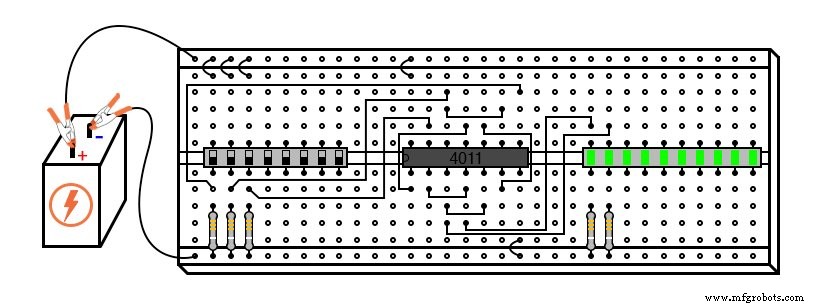
Instructions
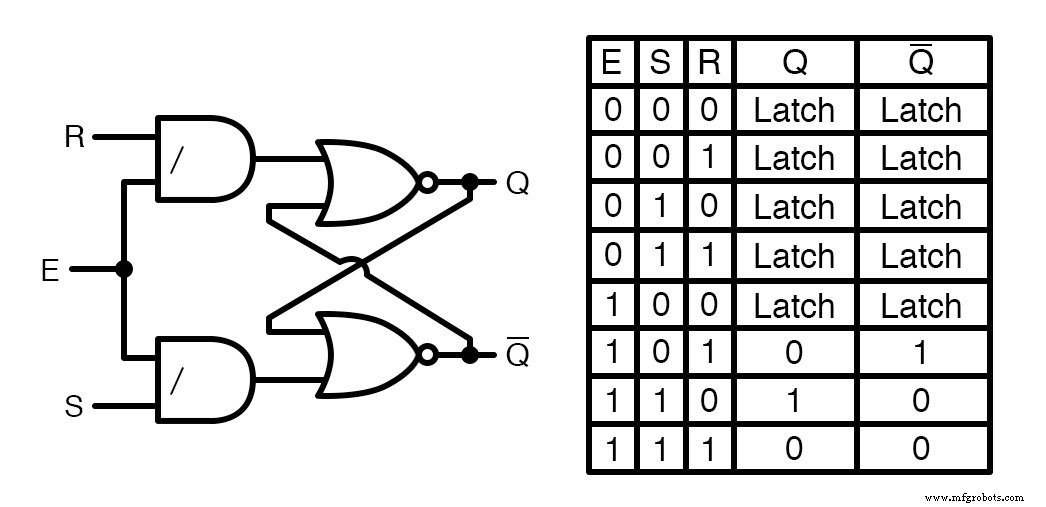
The circuit replaces the traditional NOR‑gate SR latch with NAND gates, yielding the same logical behavior: a high Set input drives Q high, and a high Reset input drives Q̅ high. The added Enable input acts as a gate, allowing or blocking the influence of Set and Reset.
When Enable is high, the latch behaves exactly like a standard SR latch. When Enable is low, both Set and Reset are ignored, and the latch retains its previous state. This gated configuration is often called a gated SR latch.
Although a gated latch can be built with two NOR gates and two AND gates, using a single 4011 IC simplifies construction, as all four NAND gates are packaged together.
Related Worksheet
Industrial Technology
- Designing and Verifying a Basic NAND Gate Circuit with the 4011 IC
- NOR Gate SR Latch: Building and Understanding Digital Memory
- Building a NAND‑Based Set‑Reset Flip‑Flop Circuit
- Understanding Multiple-Input Logic Gates: Functions, Truth Tables, and Practical Applications
- TTL NAND and AND Gate Implementation Using Open‑Collector Transistor Circuits
- Understanding TTL NOR and OR Gates: Circuit Analysis and Conversion
- Special-Output Logic Gates: Complementary, Tristate, and Bilateral Switches
- The S‑R Latch: Fundamentals, Race Conditions, and Practical Applications
- Gated SR Latch: Enhancing Logic Control with an Enable Input
- The Definitive Guide to Logic Gate Truth Tables