Industrial manufacturing

The term network programming refers to writing programs that execute across multiple devices (computers), in which the devices are all connected to each other using a network. The java.net package of the J2SE APIs contains a collection of classes and interfaces that provide the low-level communicat
Java provides a mechanism, called object serialization where an object can be represented as a sequence of bytes that includes the objects data as well as information about the objects type and the types of data stored in the object. After a serialized object has been written into a file, it can be
It would be nice if we could write a single sort method that could sort the elements in an Integer array, a String array, or an array of any type that supports ordering. Java Generic methods and generic classes enable programmers to specify, with a single method declaration, a set of related method
Prior to Java 2, Java provided ad hoc classes such as Dictionary, Vector, Stack, and Properties to store and manipulate groups of objects. Although these classes were quite useful, they lacked a central, unifying theme. Thus, the way that you used Vector was different from the way that you used Pro
The data structures provided by the Java utility package are very powerful and perform a wide range of functions. These data structures consist of the following interface and classes − Enumeration BitSet Vector Stack Dictionary Hashtable Properties All these classes are now legacy and Java-
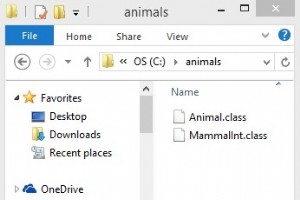
Packages are used in Java in order to prevent naming conflicts, to control access, to make searching/locating and usage of classes, interfaces, enumerations and annotations easier, etc. A Package can be defined as a grouping of related types (classes, interfaces, enumerations and annotations ) prov
An interface is a reference type in Java. It is similar to class. It is a collection of abstract methods. A class implements an interface, thereby inheriting the abstract methods of the interface. Along with abstract methods, an interface may also contain constants, default methods, static methods,
Encapsulation is one of the four fundamental OOP concepts. The other three are inheritance, polymorphism, and abstraction. Encapsulation in Java is a mechanism of wrapping the data (variables) and code acting on the data (methods) together as a single unit. In encapsulation, the variables of a clas
As per dictionary, abstraction is the quality of dealing with ideas rather than events. For example, when you consider the case of e-mail, complex details such as what happens as soon as you send an e-mail, the protocol your e-mail server uses are hidden from the user. Therefore, to send an e-mail
Polymorphism is the ability of an object to take on many forms. The most common use of polymorphism in OOP occurs when a parent class reference is used to refer to a child class object. Any Java object that can pass more than one IS-A test is considered to be polymorphic. In Java, all Java objects
In the previous chapter, we talked about superclasses and subclasses. If a class inherits a method from its superclass, then there is a chance to override the method provided that it is not marked final. The benefit of overriding is: ability to define a behavior thats specific to the subclass type,
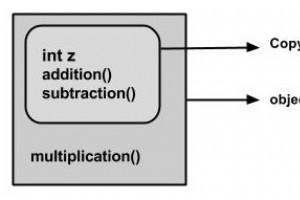
Inheritance can be defined as the process where one class acquires the properties (methods and fields) of another. With the use of inheritance the information is made manageable in a hierarchical order. The class which inherits the properties of other is known as subclass (derived class, child clas
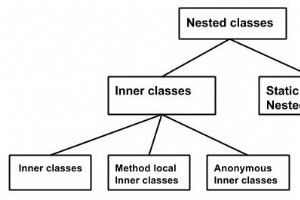
In this chapter, we will discuss inner classes of Java. Nested Classes In Java, just like methods, variables of a class too can have another class as its member. Writing a class within another is allowed in Java. The class written within is called the nested class, and the class that holds the inne
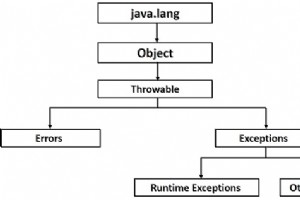
An exception (or exceptional event) is a problem that arises during the execution of a program. When an Exception occurs the normal flow of the program is disrupted and the program/Application terminates abnormally, which is not recommended, therefore, these exceptions are to be handled. An excepti
The java.io package contains nearly every class you might ever need to perform input and output (I/O) in Java. All these streams represent an input source and an output destination. The stream in the java.io package supports many data such as primitives, object, localized characters, etc. Stream A
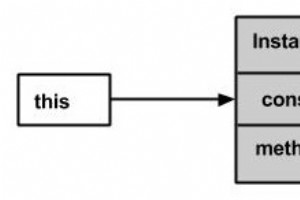
A Java method is a collection of statements that are grouped together to perform an operation. When you call the System.out.println() method, for example, the system actually executes several statements in order to display a message on the console. Now you will learn how to create your own methods
Java provides the java.util.regex package for pattern matching with regular expressions. Java regular expressions are very similar to the Perl programming language and very easy to learn. A regular expression is a special sequence of characters that helps you match or find other strings or sets of
Java provides the Date class available in java.util package, this class encapsulates the current date and time. The Date class supports two constructors as shown in the following table. Sr.No. Constructor & Description 1 Date( ) This constructor initializes the object with the current date
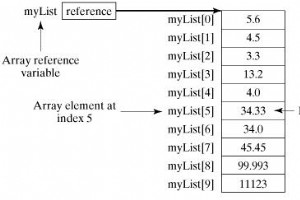
Java provides a data structure, the array, which stores a fixed-size sequential collection of elements of the same type. An array is used to store a collection of data, but it is often more useful to think of an array as a collection of variables of the same type. Instead of declaring individual va
Strings, which are widely used in Java programming, are a sequence of characters. In Java programming language, strings are treated as objects. The Java platform provides the String class to create and manipulate strings. Creating Strings The most direct way to create a string is to write −
Java