



Retractable Plungers: How They Work and Why They Matter
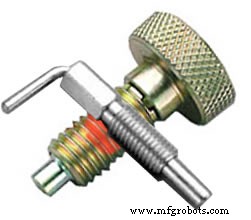
Retractable plungers—also called indexing plungers—are precision tools that secure workpieces during machining, assembly, or inspection. Unlike standard plungers, they can be manually withdrawn, giving operators quick access to the part without disturbing its position.
Key Features of Retractable Plungers
• Manual retraction via a handle or pull ring
• Secure positioning with a tapered nose
• Compatible with stainless steel, carbon steel, brass, and other alloys
How They Operate
A retractable plunger clamps onto a workpiece with its nose. When the operator pulls the handle or ring, the internal spring disengages, allowing the plunger to retract smoothly into its housing. This action frees the part for repositioning or removal.
Variations in Design
Retractable plungers come in several configurations:
- Hand‑retractable: Features a lever handle for manual release.
- Pull‑ring: Equipped with a ring that the user pulls to disengage.
- Knurled‑head: A textured head replaces both handle and ring, providing a firm grip and a clean appearance. Knurled heads are commonly made from stainless steel, carbon steel, or brass.
Applications in Industry
Manufacturers rely on retractable plungers in CNC machining, metal forming, and quality control. Their ability to lock a part firmly while allowing rapid release makes them indispensable for high‑volume production and precision tasks.
Conclusion
Retractable plungers offer a blend of stability and flexibility that standard plungers cannot match. Whether you need a simple handle, a pull ring, or a knurled head, the right design can improve workflow efficiency and ensure repeatable positioning.
Industrial equipment
- Diamond Turning: Precision Machining for Advanced Optics and Beyond
- Ultrasonic Machining Explained: Process, Benefits, and Limitations
- Rotational Molding: The Complete Guide to Creating Hollow Plastic Parts
- Chrome Plating Explained: Process, Steps, and Applications
- What Is a Punch Tool? A Woodworker’s Essential Guide
- Friction Drilling Explained: Heat‑Generated Cutting for Faster, Cleaner Holes
- Understanding Ball Plungers: Design, Function, and Applications
- Spring vs. Ball Plungers: Key Differences & When to Use Each
- Understanding the Oxygen (O2) Sensor: Role, Placement, and Failure Signs
- Decoding 'N' in Pump Calculations: Its Role and Significance