



Fullerene Peapods: Encapsulation, Synthesis, and Applications in Nanotechnology
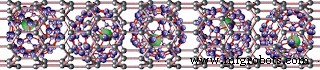
Fullerene Peapods
Single‑walled carbon nanotubes (SWNTs) create a protected interior cavity that can be filled with molecules such as fullerenes. When C60 or other fullerene species are encapsulated inside SWNTs, the resulting hybrid is known as a fullerene peapod. These structures combine the unique electronic properties of both constituents and exhibit dimensionality‑dependent physical behavior.
Encapsulation
Fullerenes, endohedral metallofullerenes, and alkali halides have all been successfully inserted into SWNT interiors. The encapsulated species can modify or enhance the mechanical and electronic characteristics of the host tube, and the properties can be tuned by thermal post‑treatments. For example, Nagoya University researchers inserted Gd‑doped C82 cages into SWNTs, achieving a measurable shift in the buckyball electronic structure.
Synthesis
The most common peapod is the C60 peapod. Its fabrication typically involves mixing purified SWNTs with C60 powder, evacuating the mixture, and heating it above C60’s sublimation point for several days. Although effective, this vacuum‑heat method is not scalable and can introduce unwanted fullerene impurities.
To reduce impurities, a typical cleaning protocol heats soot in vacuum, then refluxes the fullerene‑free soot in an H2O2 solution to remove amorphous carbon. The resulting SWNTs, now capped and defect‑rich, are pressed into thin black paper, dried under vacuum, and are ready for filling.
Sample Preparation
Commercial SWCNTs derived from arc‑discharge are purified by repeated high‑temperature air and acid washes, followed by triple H2O2 refluxing and HCl etching. After filtration and degassing, the SWNT paper is ready for either vapor‑ or solvent‑filling, depending on the desired fullerene species and tube diameter distribution.
Filling Methods
Vapor‑Filling
SWNTs and fullerene powder are sealed in a quartz ampoule, degassed, and heated at a modest temperature. The product is then sonicated in toluene to remove non‑reacted fullerene, filtered, and dried under dynamic vacuum.
Solvent‑Filling
In n‑hexane, SWNTs are mixed with C60 or C70. After drying to eliminate moisture, the mixture is sonicated to partially dissolve C60. The resulting solution is refluxed, filtered, and the resulting buckypaper is washed with toluene or subjected to vacuum to eliminate surface‑bound fullerene.
Applications
Upon high‑temperature annealing, fullerene peapods transform into double‑wall carbon nanotubes (DWCNTs) as the fullerenes coalesce into an inner tube. DWCNTs retain the electronic properties of the host while offering superior mechanical strength, making them attractive for electronic devices, scanning probe tips, field‑emission cathodes, and potential quantum‑computing elements.
Peapods containing metallofullerenes exhibit band‑gap modulation due to electron transfer between the metal core and the carbon host, enabling novel field‑effect transistor designs. Under extreme pressure, peapods can act as micro‑autoclaves, promoting reactions within confined spaces.
Nanomaterials
- IBM Breakthroughs in 7nm BEOL Technology: EUV Lithography and Cobalt Metallization Propel Next‑Gen Chips
- IBM Engineers Develop Nanoscopic Thermometer, Enabling Precise Temperature Mapping of Quantum Devices
- IBM 5 in 5: On‑Chip Medical Labs Detect Disease at the Nanoscale
- IBM Breaks New Ground with 7 nm FinFET Technology Using EUV Lithography
- IBM's Air Spacer Innovation Paves Way for 10 nm FinFET Chips
- Fullerene Peapods: Encapsulation, Synthesis, and Applications in Nanotechnology
- Paramagnetic Behavior of Fullerene-Derived Nanomaterials and Their Polymer Composites: A Comprehensive EPR Study
- Evaluating C60 Fullerene's Modulation of Diphenyl‑N‑(Trichloroacetyl)amidophosphate-DNA Binding and Cytotoxicity in Human Leukemia Cells
- Synergistic Flame Retardancy of Fullerene‑Anchored Reduced Graphene Oxide Hybrids in Epoxy Resin
- C60 Fullerene Nanocomplexes Boost Doxorubicin Potency Against Leukemia Cells In Vitro