



Voltage Comparator Circuit – Build and Test with a Dual Op‑Amp
Introduction
A voltage comparator is a fundamental building block in analog electronics, enabling a circuit to decide which of two input voltages is higher. In this tutorial you’ll construct a simple, hands‑on comparator using a single dual operational amplifier, observe the result with an LED, and explore practical applications such as wind‑speed alarms.
Parts and Materials
- Operational amplifier: model 1458 or 353 (Radio Shack catalog # 276‑038 / 900‑6298) – a dual‑op‑amp in an 8‑pin DIP package.
- Three 6 V batteries (provides 0 V to +18 V supply rails).
- Two 10 kΩ linear‑taper potentiometers (Radio Shack # 271‑1715).
- 1 × LED (Radio Shack # 276‑026 or equivalent).
- 1 × 330 Ω resistor.
- 1 × 470 Ω resistor.
Using a dual op‑amp is a best practice even if your design only needs one channel. It saves parts and keeps your lab kit flexible for future projects.
Cross‑References
Lessons In Electric Circuits, Volume 3, chapter 8: “Operational Amplifiers”
Learning Objectives
- Understand how an op‑amp functions as a voltage comparator.
- Build a comparator circuit and validate its operation visually with an LED.
- Explore real‑world scenarios where comparators are essential.
Schematic Diagram
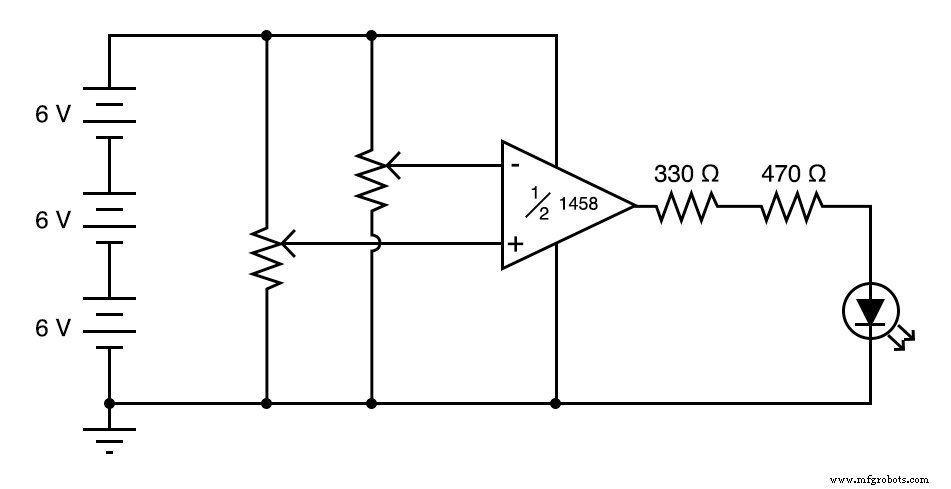
Illustration
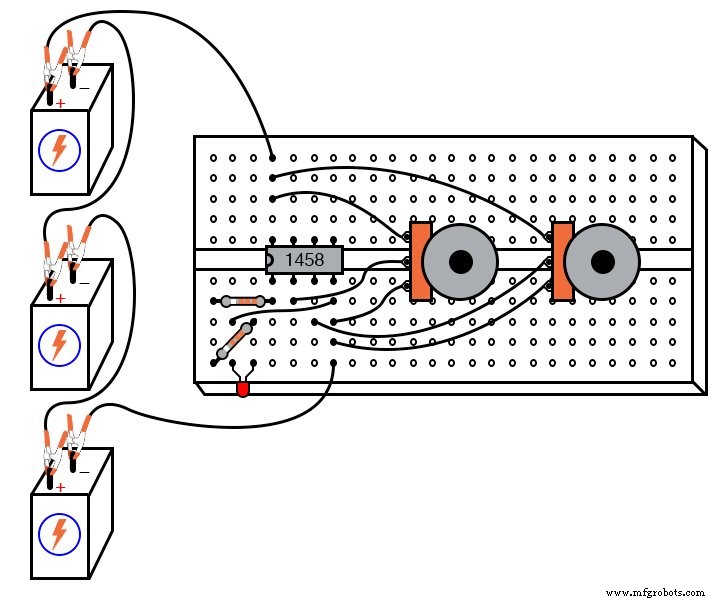
How the Comparator Works
The op‑amp’s output saturates either near the positive supply (+18 V) or near ground (0 V). When the non‑inverting input (+) receives a higher voltage than the inverting input (−), the output goes high, lighting the LED. If the inverting input is higher, the output goes low and the LED turns off.
For deeper insight, attach voltmeters to the two input terminals (referenced to ground). You’ll see the numerical values change as you turn the potentiometers, matching the LED’s on/off state.
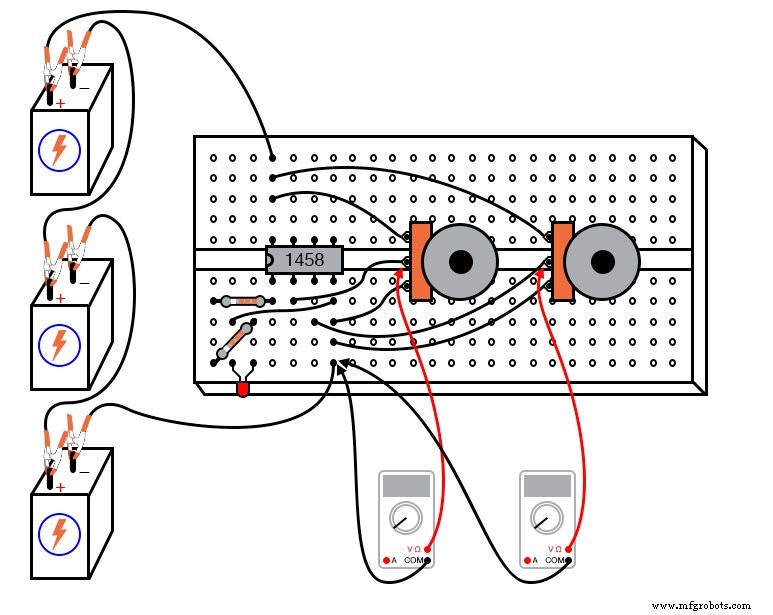
Practical Application Example
Imagine an anemometer that converts wind speed into a proportional voltage. By feeding this signal into the non‑inverting input and a fixed reference voltage into the inverting input, the comparator can trigger a high‑wind alarm when the wind speed exceeds a set threshold.
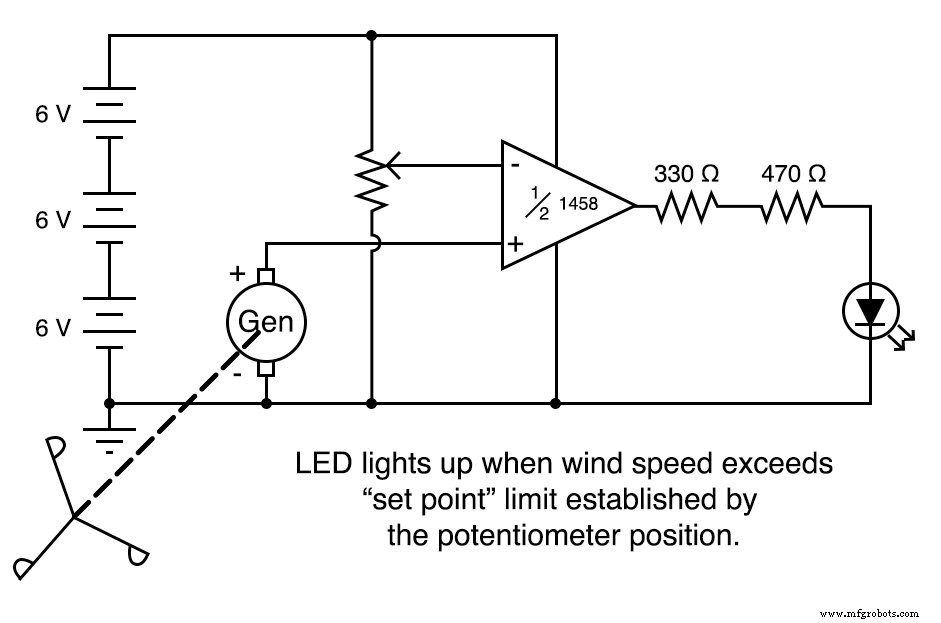
Related Worksheet
Industrial Technology
- Exploring Voltage Addition with Series Battery Connections
- Voltage Divider Lab: Design, Measurement, and Kirchhoff’s Voltage Law Verification
- Thermoelectricity: Understanding Thermocouples and the Seebeck Effect
- Potentiometric Voltmeter: Precise Voltage Measurement with Minimal Loading
- Build a Potato Battery: A Step‑by‑Step Guide to DIY Electrochemical Power
- Low‑Voltage AC Power Supply: Phase‑Shift Circuit Components & Best Practices
- Build a High‑Gain Differential Amplifier That Works as an Op‑Amp
- Practical Considerations for Operational Amplifiers
- Tachogenerators: Precision Speed Measurement for Industrial Motors and Equipment
- Understanding AC Waveforms: Sine Waves, Frequency, and Oscilloscope Basics