



Pigment Red 170: Properties, Grades, and Key Applications in Coatings & Plastics
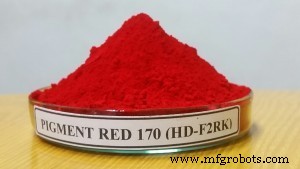
Pigment Red 170, a rare bluish‑reddish pigment, stands out in the paint and plastics industry for its exceptional transparency and superior light fastness. Widely used in polyolefins and fibers, it is available in two halogen‑free grades: F3RK and F5RK.
Grades & Key Properties
F3RK – Offers a bright yellowish hue with high hiding power, making it ideal for flexible PVC applications. Its excellent solvent resistance prevents blooming, and it blends seamlessly with molybdate orange and quinacridone in coating formulations.
F5RK – Delivers a clear bluish tone and is not used in PVC. It excels in high‑performance coatings where transparency and light fastness are critical.
Major Applications
Red 170 is insoluble in acids, water, and alkalis, and it exhibits outstanding fastness to light and weathering. It is a go‑to pigment for:
- Advanced automotive and industrial coatings
- Tool and equipment finishes
- PVC printing inks and packaging coatings
- Viscose, polypropylene, and polyester fibers
- PE, PP, PA, PC, PS, RUB, and PU paints
- Powder and coil coatings, decorative metal inks, and UV‑resistant inks
Its versatility also makes it suitable for OEM paints, textile printing, and refinish applications where durability and color strength are paramount.
The Role of Pigments in Coatings
Pigments—whether synthetic or natural—are finely ground, insoluble particles that provide color and modify the chemical and physical properties of both wet and dry films. They fall into several categories:
- Organic pigments – stable, non‑agglomerating, ideal for high‑performance paints.
- Inorganic pigments – disperse readily in resins, offering excellent weather resistance.
- Functional pigments – impart properties such as corrosion inhibition.
- Special‑effect pigments – create optical effects like metallic finishes or angle‑dependent colors.
Choosing the right pigment enhances coverage, light fastness, environmental performance, and overall product longevity.
Dye
- Hafnium Oxide (HfO₂): Structure, Properties, and Key Applications
- Voltage Sensors: How They Work & Key Applications in Modern Power Systems
- Lambda (Oxygen) Sensor: Function, Operation, and Key Automotive Applications
- Image Sensors: Types, Operation, and Practical Applications
- Gyroscope Sensors: How They Work and Their Key Applications
- Flame Sensors: How They Work and Key Applications in Fire Safety
- Sound Sensors: How They Work & Practical Applications
- Humidity Sensors: How They Work and Key Applications
- Rain Sensors Explained: How They Work & Key Applications
- Automotive Coatings & the Role of Pigment Red 170