



Hafnium Oxide (HfO₂): Structure, Properties, and Key Applications
Hafnium Oxide (HfO₂): Structure, Properties, and Key Applications
Hafnium oxide (HfO₂), commonly called hafnia, is a colorless, highly stable inorganic compound with the formula HfO₂. It is a wide‑bandgap insulator (5.3–5.7 eV) that has become indispensable in modern semiconductor technology, high‑temperature devices, and energy‑efficient coatings.
Chemical Characteristics
HfO₂ is chemically inert under ambient conditions. It reacts only with very strong acids (e.g., concentrated H₂SO₄) and bases. It dissolves slowly in hydrofluoric acid, forming fluorohafnate anions. At elevated temperatures, it reacts with chlorine in the presence of graphite or carbon tetrachloride to produce hafnium tetrachloride (HfCl₄).
Crystal Structure and Phase Behavior
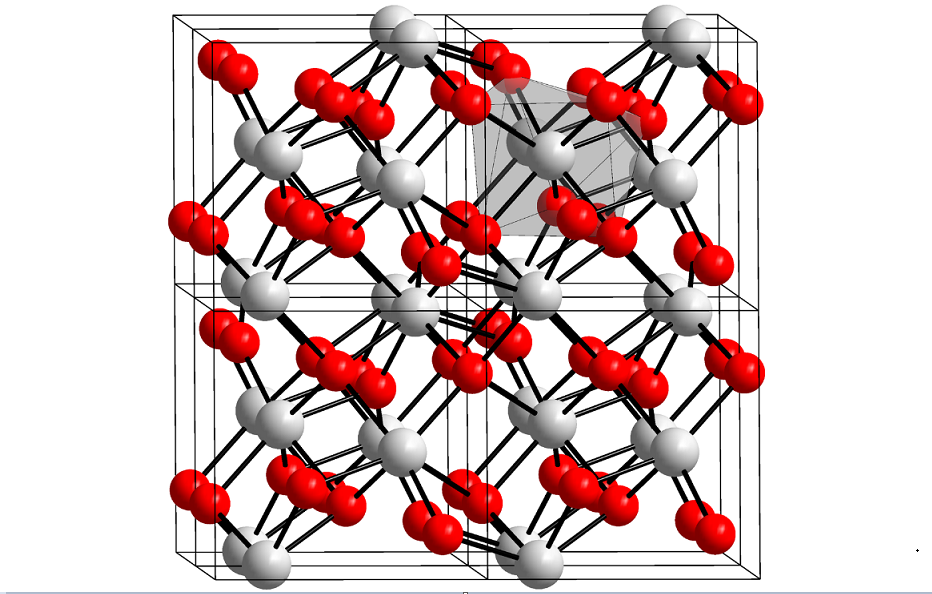
Like zirconia (ZrO₂), HfO₂ crystallizes in several polymorphs: cubic (Fm-3m), tetragonal (P4₂/nmc), monoclinic (P2₁/c), and orthorhombic (Pbca, Pnma). Two metastable orthorhombic phases (Pca₂₁ and Pmn2₁) appear over a wide range of pressures and temperatures and are believed to underlie the ferroelectricity observed in thin films. These phases feature seven‑coordinate hafnium centers, unlike TiO₂ which maintains six‑coordinate Ti in all phases.
Thin‑Film Processing
HfO₂ thin films are typically deposited by atomic layer deposition (ALD) as amorphous layers, offering excellent conformality on complex topographies. Researchers have co‑deposited hafnium oxide with silicon (forming hafnium silicates) or aluminum to raise the crystallization temperature and tailor the dielectric properties. The microstructure, deposition method, and composition directly influence the dielectric constant and overall device performance.
Semiconductor Applications
In 2007 Intel introduced HfO₂ as a gate‑insulator replacement for SiO₂ in field‑effect transistors. The dielectric constant of HfO₂ (≈ 20–25) is 4–6 times higher than that of SiO₂, enabling thinner layers and reduced leakage currents while maintaining high capacitance. It is now a standard high‑K dielectric in DRAM capacitors and advanced metal‑oxide‑semiconductor (MOS) devices.
Emerging Memory Technologies
HfO₂’s ability to undergo resistive switching and exhibit ferroelectric behavior makes it a strong candidate for resistive random‑access memory (ReRAM) and CMOS‑compatible ferroelectric memory devices. Recent studies demonstrate stable ferroelectric polarization in sub‑10 nm films, opening pathways for non‑volatile memory with high density and low power consumption.
High‑Temperature and Refractory Uses
With a melting point near 2500 °C, HfO₂ serves as a refractory material in thermocouple insulation and other high‑temperature environments. Its exceptional thermal stability also makes it suitable for components that must withstand extreme thermal cycling without degradation.
Energy‑Saving Coatings
Multilayer stacks comprising HfO₂, SiO₂, and other oxides have been engineered for passive building cooling. These films reflect solar radiation while emitting infrared radiation that escapes the atmosphere, achieving surface temperatures several degrees lower than conventional coatings under identical conditions.
Conclusion
Hafnium oxide’s unique combination of high dielectric constant, chemical inertness, ferroelectric potential, and thermal resilience underpins its growing role across electronics, energy, and high‑temperature industries. Continued research into its phase behavior and thin‑film engineering promises further advancements in next‑generation devices.
For more information on hafnium and other refractory metals, visit Advanced Refractory Metals (ARM), a global leader in refractory metal supply.
Metal
- 4 Key Applications of Hafnium: From Electronics to Aerospace
- Top 10 Properties of Aluminium and Their Industrial Applications
- Voltage Sensors: How They Work & Key Applications in Modern Power Systems
- Lambda (Oxygen) Sensor: Function, Operation, and Key Automotive Applications
- Image Sensors: Types, Operation, and Practical Applications
- Gyroscope Sensors: How They Work and Their Key Applications
- Flame Sensors: How They Work and Key Applications in Fire Safety
- Sound Sensors: How They Work & Practical Applications
- Humidity Sensors: How They Work and Key Applications
- Rain Sensors Explained: How They Work & Key Applications