Industrial manufacturing
Nanomaterials

AbstractWe introduce a facile ultraviolet (UV) ozone (UVO) treatment protocol for tin oxide (SnO2) electron transport layers (ETLs) fabricated at temperatures below 90 °C. By optimizing the SnO2 precursor concentration, we control film thickness, achieve high crystallinity, and remove organic residu
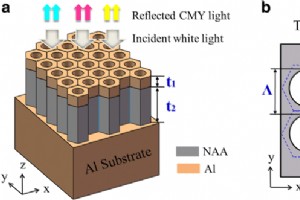
AbstractWe demonstrate a scalable, high‑efficiency structural color filter that combines a nanoporous anodic alumina (NAA) layer with a thin aluminum (Al) coating atop an optically thick Al substrate. The NAA, a self‑assembled hexagonal nanopore array, behaves as a quasi‑homogeneous medium and, toge
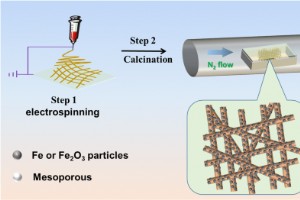
AbstractHigh‑performance electrocatalysts for the oxygen reduction reaction (ORR) are essential for electrochemical energy storage and conversion. Fe‑N‑C materials have emerged as the most promising non‑precious alternative to platinum, yet conventional synthesis often requires high‑temperature ther
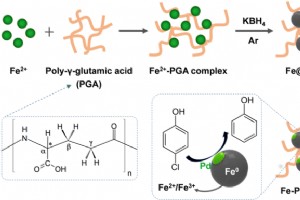
Abstract3 h in weakly alkaline solution (pH ≈ 9). Using p‑chlorophenol (p‑CP) as a model, Fe‑Pd@PGA NPs achieve a maximum pseudo‑first‑order rate constant of 0.331 min⁻¹ at an Fe/p‑CP molar ratio of 100. This rate exceeds that of bare Fe‑Pd NPs by more than tenfold, underscoring PGA’s role as a st
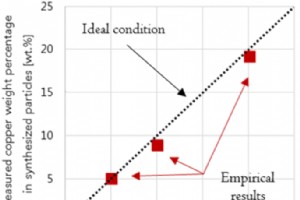
AbstractWe report an in‑situ synthesis of tungsten‑x wt% copper (x = 5, 10, 20) bimetallic nanoparticles via inductively coupled radio‑frequency (RF) thermal plasma. The process reduces tungsten trioxide (WO₃) and cupric oxide (CuO) to metallic W and Cu under a hydrogen atmosphere, yielding uniforml
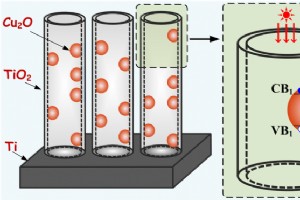
AbstractBased on highly ordered TiO2 nanotube arrays (NTAs), we successfully fabricated the Cu2O-TiO2 NTA heterojunction by a simple thermal decomposition process for the first time. The anodic TiO2 NTAs were functioned as both “nano-container” and “nano-reactors” to load and synthesize the narrow b
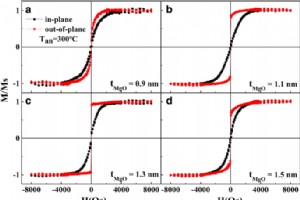
AbstractWe report that a Ta/Pd/CoFeMnSi (CFMS)/MgO/Pd multilayer stack exhibits robust perpendicular magnetic anisotropy (PMA). By annealing at 300 °C the effective anisotropy constant reaches Keff = 5.6×10⁵ erg cm−3 (5.6×10⁴ J m−3). In addition, the magnetic state of the film is highly responsive t
![Thiacalix[4]arenes Counteract Zinc‑Induced Inhibition of Uterine Myosin ATPase Activity](https://www.mfgrobots.com/article/uploadfiles/202112/2021122511532876_S.png)
AbstractZinc is essential for cellular function, yet concentrations above 5 mM markedly suppress the ATPase activity of uterine myosin S1, impairing smooth‑muscle contractility. We quantified this inhibition, showing a 1.6‑fold drop in Vmax (38 ± 7 → 22 ± 6 nmol Pi min−1 mg−1) while Km remained unch
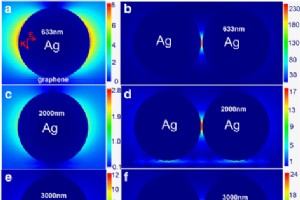
AbstractBy exploiting the image‑charge effect on a metal film, incident light can be confined to the film surface when a metal nanoparticle dimer is positioned nearby. This phenomenon, termed electromagnetic field redistribution, is investigated here for the first time on a hybrid of silver nanopar
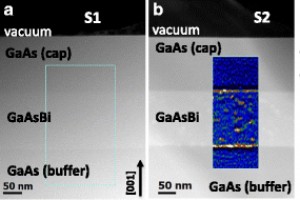
Abstract Using aberration‑corrected high‑angle annular dark‑field (HAADF) STEM, we examined the distribution of Bismuth (Bi) in molecular‑beam‑epitaxy (MBE)–grown GaAs/GaAs1-xBix/GaAs heterostructures fabricated at a substrate temperature near 340 °C. Low‑magnification HAADF images, corroborated by
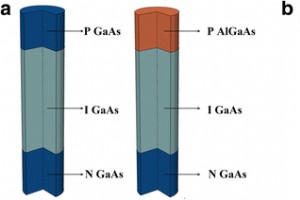
AbstractWe demonstrate a substantial performance boost for GaAs nanowire (NW) pin‑junction array solar cells by incorporating AlGaAs/GaAs heterojunctions. In axial structures, AlGaAs forms the top p‑type segment, while in radial devices it constitutes the outer p‑type shell. The AlGaAs layers act si
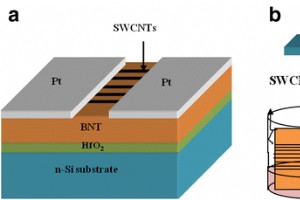
AbstractWe have engineered ferroelectric field‑effect transistors (FeFETs) that use single‑walled carbon nanotube (SWCNT) stripes as the channel, a (Bi,Nd)₄Ti₃O₁₂ (BNT) ferroelectric film as the gate dielectric, and a thin HfO₂ layer as a defect‑control buffer. The resulting devices exhibit a high
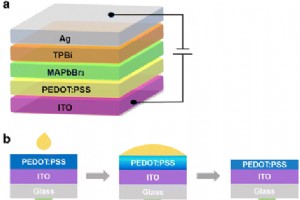
Abstract Perovskite light‑emitting diodes (PeLEDs) built on an ITO/PEDOT:PSS/CH3NH3PbBr3/TPBi/Ag stack benefit substantially from a simple spin‑coat treatment of the PEDOT:PSS layer with high‑polarity alcohols. Methanol (MeOH) treatment elevates the maximum luminance to 2075 cd m−2 and current effic

AbstractA facile, cost-effective, non-toxic, and surfactant-free route has been developed to synthesize MoS2/carbon (MoS2/C) nanocomposites. Potassium humate consists of a wide variety of oxygen-containing functional groups, which is considered as promising candidates for functionalization of graphe
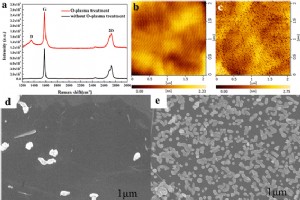
AbstractThis study elucidates the nucleation and growth of GaN epitaxial layers on mechanically exfoliated graphite using classic nucleation theory. Oxygen‑plasma treatment introduces surface defects, thereby increasing nucleation density. Incorporation of elemental Al markedly boosts the nucleation
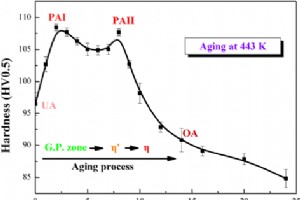
Abstract50 at.% Al, whereas those above ~5 nm contain <40 at.% Al. The transformation from Guinier–Preston (G.P.) zones to the equilibrium η phase proceeds via an η′ intermediate that incorporates more Mg and Zn, displacing Al. In the first aging peak, G.P. zones comprise ~85 % of all nanoparticles,
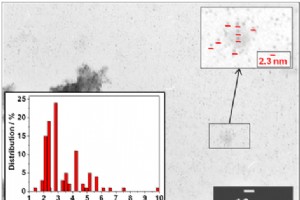
AbstractWe report the first synthesis of water‑soluble CdTe quantum dots alloyed with Mn²⁺ that emit blue photoluminescence. Using a controlled ion‑exchange protocol at neutral pH, we produced a series of Cd1‑xMnxTe QDs with a narrow size distribution (average diameter 2.3 ± 0.3 nm). Photoluminescen
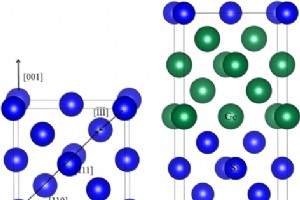
AbstractUsing ab initio molecular dynamics, we examine how low‑energy ion irradiation affects bulk silicon (Si), bulk germanium (Ge), and a Si/Ge superlattice (SL). The study reveals that Ge atoms at the SL interface retain a displacement resistance similar to bulk Ge, whereas Si atoms near the int
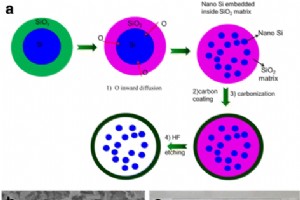
AbstractSilicon/carbon (Si/C) composites are promising anodes for lithium‑ion batteries (LIBs) because of silicon’s theoretical capacity of 4,200 mAh g⁻¹. However, most Si/C materials rely on costly, low‑yield nano‑silicon synthesis. In this study, we show that silicon sludge—a by‑product of the pho
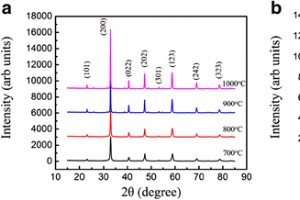
AbstractWe report on microstructural, magnetic, and optical properties of Pr-doped perovskite manganite (La1 − xPrx)0.67Ca0.33MnO3 (LPCMO, x = 0.0–0.5) nanoparticles synthesized via sol-gel process. Structural characterizations (X-ray and electron diffraction patterns, (high resolution) TEM images)
Nanomaterials