Industrial manufacturing
Industrial Technology

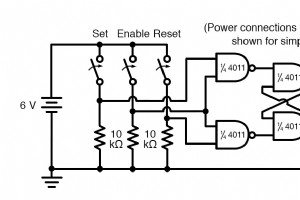
Components and Materials 4011 quad NAND gate (Radio Shack catalog # 276-2411) Eight‑position DIP switch (Radio Shack catalog # 275-1301) Ten‑segment bar graph LED (Radio Shack catalog # 276-081) 1 × 6 V battery 3 × 10 kΩ resistors 2 × 470 Ω resistors Important Note: The 4011 IC is CMOS and highly
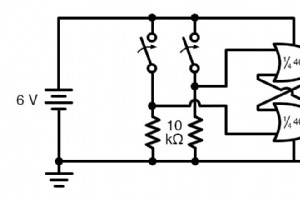
Parts and Materials 4001 quad NOR gate (Radio Shack catalog # 276-2401) Eight‑position DIP switch (Radio Shack catalog # 275-1301) Ten‑segment bar graph LED (Radio Shack catalog # 276-081) One 6 volt battery Two 10 kΩ resistors Two 470 Ω resistors Two 100 Ω resistors Caution! The
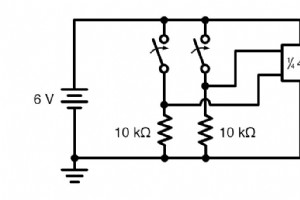
Parts and Materials 4011 quad NAND gate (Radio Shack catalog # 276‑2411) Eight‑position DIP switch (Radio Shack catalog # 275‑1301) Ten‑segment bar graph LED (Radio Shack catalog # 276‑081) One 6‑volt battery Two 10 kΩ resistors Three 470 Ω resistors Caution! The 4011 IC is CMOS and is highly sens
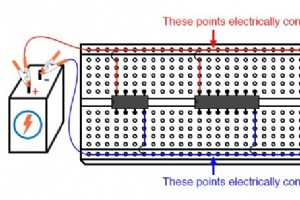
Digital circuits operate on binary levels—either a strict zero or a full‑scale voltage—unlike analog circuits that allow continuous signal variation between supply limits. These discrete signals enable reliable logical operations and computation in modern electronics. At the heart of every digital s
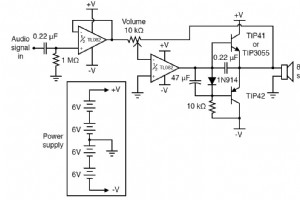
Components and Materials Four 6 V batteries Dual op‑amp (TL082 recommended – Radio Shack #276‑1715) 1 × NPN power transistor, TO‑220 package (TIP41, #276‑2020 or equivalent) 1 × PNP power transistor, TO‑220 package (TIP42, #276‑2027 or equivalent) 1 × 1N914 switching diode (Radio Shack #276‑1620) 1
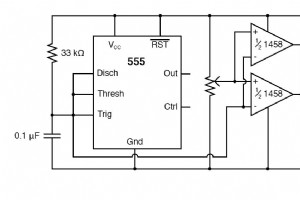
Parts and Materials Four 6‑volt batteries 100 µF electrolytic capacitor, 35 WVDC (e.g., Radio Shack #272‑1028) 0.1 µF non‑polarized capacitor (Radio Shack #272‑135) 555 timer IC (Radio Shack #276‑1723) Dual operational amplifier, 1458 (Radio Shack #276‑038) NPN power transistor (Radio Shack #276‑20
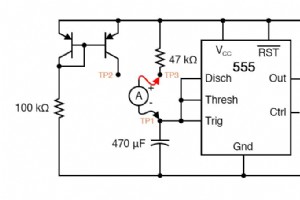
Parts and Materials Two 6 V batteries (or a 12 V supply) 470 µF electrolytic capacitor, 35 V rating (Radio Shack #272‑1030 or equivalent) 0.1 µF non‑polarized capacitor (Radio Shack #272‑135) 555 timer IC (Radio Shack #276‑1723) Two PNP transistors (2N2907 or 2N3906 recommended; Radio Shack #276‑16
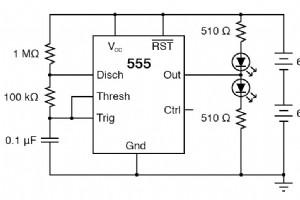
Parts & Materials Two 6‑V batteries 0.1 µF non‑polarized capacitor (Radio Shack #272‑135) 555 timer IC (Radio Shack #276‑1723) Two LEDs (Radio Shack #276‑026 or equivalent) 1 MΩ resistor 100 kΩ resistor Two 510 Ω resistors Audio detector with headphones Oscilloscope (recommended but not required
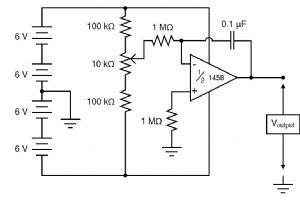
PARTS AND MATERIALS Four 6‑volt batteries Operational amplifier (model 1458, Radio Shack catalog #276‑038) 10 kΩ linear‑taper potentiometer (Radio Shack #271‑1715) Two 0.1 µF non‑polarized capacitors (Radio Shack #272‑135) Two 100 kΩ resistors Three 1 MΩ resistors Any modern op‑amp will run
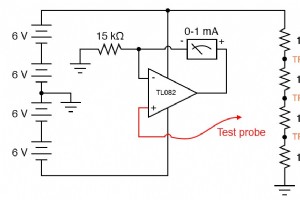
Parts and Materials Operational amplifier – TL082 (Radio Shack catalog #276‑1715) Operational amplifier – LM1458 (Radio Shack catalog #276‑038) Four 6 V batteries 1 mA meter movement (0‑15 VDC rating, Radio Shack catalog #22‑410) 15 kΩ precision resistor (±1 % tolerance) Four 1 MΩ resistors (any hi
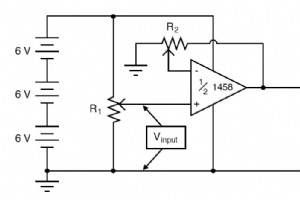
PARTS AND MATERIALS Operational amplifier: model 1458 or 353 (Radio Shack catalog # 276‑038 / # 900‑6298) Three 6 V batteries Two 10 kΩ linear‑taper potentiometers (Radio Shack catalog # 271‑1715) CROSS‑REFERENCES Lessons In Electric Circuits, Volume 3, Chapter 8: “Operational Amplifiers” LEARNING
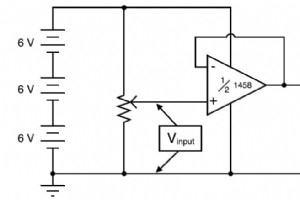
Parts and Materials Operational amplifier: model 1458 or 353 (Radio Shack catalog # 276‑038 and # 900‑6298, respectively) Three 6‑volt batteries 10 kΩ linear‑taper potentiometer (Radio Shack catalog # 271‑1715) Cross‑References Lessons In Electric Circuits, Volume 3, Chapter 8: “Operational Ampli
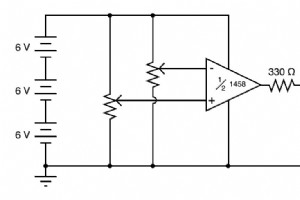
Introduction A voltage comparator is a fundamental building block in analog electronics, enabling a circuit to decide which of two input voltages is higher. In this tutorial you’ll construct a simple, hands‑on comparator using a single dual operational amplifier, observe the result with an LED, and

Analog circuits handle signals that vary continuously between zero and the supply voltage, in contrast to digital circuits, which use discrete voltage levels—typically 0 V or full supply. Although these circuits are often called linear, the term can be misleading; a circuit’s output need not be a st
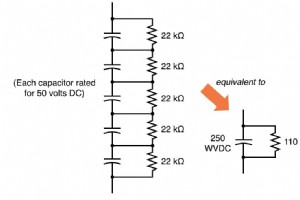
PARTS AND MATERIALS One 12AX7 dual triode vacuum tube Two power transformers, 120VAC step-down to 12VAC (Radio Shack catalog # 273-1365, 273-1352, or 273-1511). Bridge rectifier module (Radio Shack catalog # 276-1173) Electrolytic capacitor, at least 47 µF, with a working voltage of at least
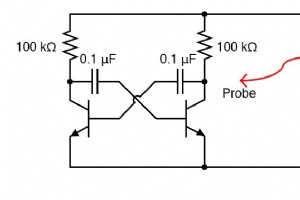
PARTS AND MATERIALS Two 6‑volt batteries Three NPN transistors (2N2222 or 2N3403 recommended; Radio Shack catalog # 276‑1617 contains a convenient 15‑pack) Two 0.1 µF capacitors (Radio Shack catalog # 272‑135 or equivalent) One 1 MΩ resistor Two 100 kΩ resistors One 1 kΩ resistor Assorted resistor
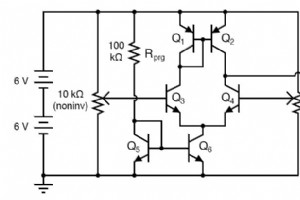
Parts and Materials Two 6‑volt batteries Four NPN transistors—models 2N2222 or 2N3403 (Radio Shack catalog # 276‑1617 provides a convenient pack of fifteen NPN devices) Two PNP transistors—models 2N2907 or 2N3906 (Radio Shack catalog # 276‑1604 offers a pack of fifteen PNPs) Two 10 kΩ potentiometer
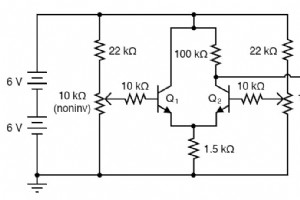
Parts and Materials Two 6‑V batteries Two NPN transistors (2N2222 or 2N3403 recommended – see Radio Shack catalog #276‑1617 for a convenient package of fifteen) Two 10 kΩ single‑turn linear potentiometers (Radio Shack catalog #271‑1715) Two 22 kΩ resistors Two 10 kΩ resistors One 100 kΩ resistor On
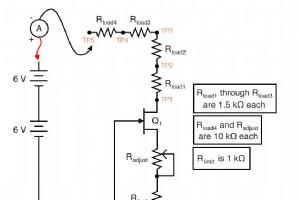
PARTS AND MATERIALS One N‑channel junction field‑effect transistor (JFET), such as the 2N3819 or J309 (Radio Shack catalog #276‑2035). Two 6‑V batteries. One 10 kΩ single‑turn, linear‑taper potentiometer (Radio Shack catalog #271‑1715). One 1 kΩ resistor. One 10 kΩ resistor. Three 1.5 kΩ resistors.
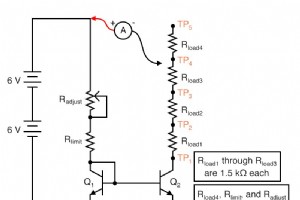
Parts and Materials Two NPN transistors (2N2222 or 2N3403 recommended; Radio Shack #276‑1617 offers a 15‑piece pack) Two 6‑V batteries 10 kΩ linear potentiometer (Radio Shack #271‑1715) Two 10 kΩ resistors Four 1.5 kΩ resistors Using small‑signal transistors lets you observe the subtle “thermal ru
Industrial Technology