Industrial manufacturing
Industrial Technology

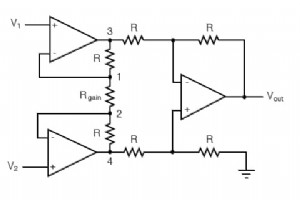
What Is an Instrumentation Amplifier? An instrumentation amplifier gives engineers the ability to fine‑tune a circuit’s gain by altering just one resistor, unlike a conventional differential amplifier that requires multiple resistor changes. Built on the differential amplifier’s foundation, it adds
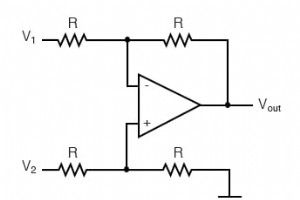
Differential Op-Amp Circuits An op-amp with no feedback is already a differential amplifier, amplifying the voltage difference between the two inputs. However, its gain cannot be controlled, and it is generally too high to be of any practical use. So far, our application of negative feedback to op-
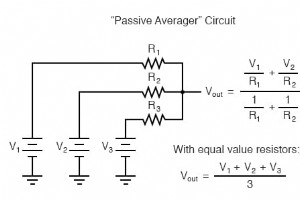
When three identical resistors share a common node, each fed with a separate voltage source, the voltage at that node is the arithmetic mean of the three inputs. This simple arrangement is the classic passive averager and is a direct application of Millman’s Theorem, which predicts the node voltage
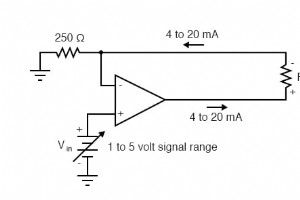
In modern instrumentation, DC signals serve as analog proxies for physical variables such as temperature, pressure, flow, weight, and motion. The industry’s preferred format is a DC current signal—typically 4 mA to 20 mA—because current remains uniform throughout a series loop, irrespective of wire
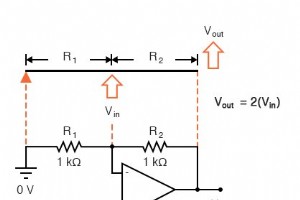
To demystify divided‑feedback amplifier circuits, we can turn to a familiar mechanical system: a lever. The lever’s moving ends represent input and output voltages, while the pivot—whether a physical ground or a virtual one—acts as the feedback reference. Consider the classic non‑inverting op‑amp sh
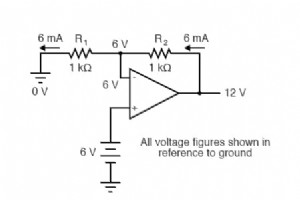
Adding a voltage divider to the negative‑feedback path of an op‑amp means only a fraction of the output feeds back to the inverting input. The result is an output that is a predictable multiple of the input. The power‑supply connections are omitted here for simplicity. With R1 = R2 = 1 kΩ and a 6‑V

When the output of an operational amplifier is routed back to its inverting input while a signal is applied to the non‑inverting input, the device operates in a self‑correcting mode. In this configuration the op‑amp’s output tracks the input voltage almost exactly, thanks to negative feedback. As t
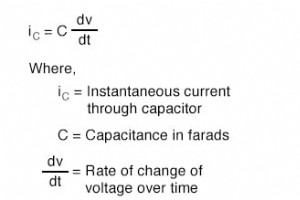
Before digital electronics, computers performed calculations by translating numbers into voltages and currents. By using resistive voltage dividers and amplifiers, basic arithmetic operations—division and multiplication—could be carried out on these analog signals. This approach proved especially va
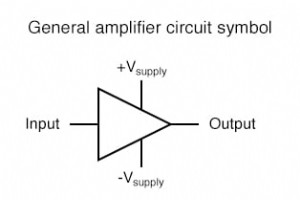
Single‑Ended vs. Differential Amplifiers In circuit design, the complex internals of an amplifier are often collapsed into a single triangle symbol. This abstraction keeps schematics readable while still conveying the essential function of the device. The symbol shows two power‑supply pins (+V and
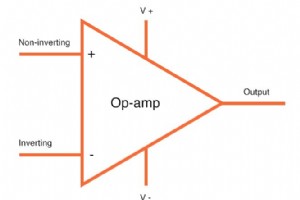
What is an Operational Amplifier (Op-amp)? Operational amplifiers, or op‑amps, are voltage‑amplifying integrated circuits designed to work in concert with passive components such as resistors and capacitors. By placing external feedback elements around the device, engineers can shape its behavior to
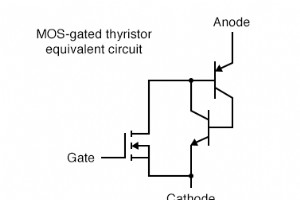
Recent advances in thyristor technology aim to lower the gate trigger current required for conventional silicon‑controlled rectifiers (SCRs). Two notable innovations are the MOS‑Gated Thyristor (MGT) and the MOS‑Controlled Thyristor (MCT). MOS‑Gated Thyristor (MGT) The MGT integrates an N‑channel MO
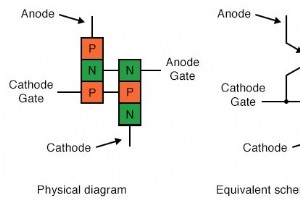
Incorporating an additional external terminal into the classic SCR equivalent circuit yields the silicon‑controlled switch (SCS). The extra terminal, connected to the base of the upper transistor and the collector of the lower transistor, grants an extra degree of control, particularly enabling forc
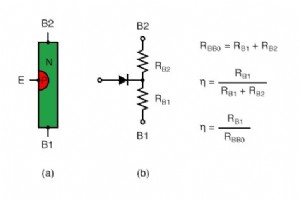
What is a Unijunction Transistor (UJT)? A UJT is a three‑terminal silicon device that, although not a thyristor, can trigger larger thyristors by delivering a sharp pulse to its base‑B1. It is built from an N‑type silicon bar with a centrally located P‑type region. The two ends of the bar are the ba
Optothyristors are light‑activated semiconductor switches that replace the traditional triggering voltage with an optical signal. This technology is used in high‑reliability applications where electrical isolation is critical. There are two main types of optothyristors: Light‑Activated SCRs (LASCRs
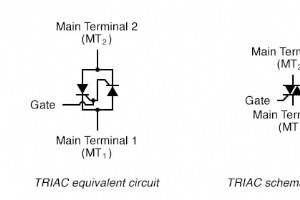
TRIACs are the bidirectional counterparts of silicon controlled rectifiers (SCRs). By connecting two SCRs back‑to‑back, a TRIAC can conduct current in both directions, making it ideal for AC power control. TRIAC: SCR equivalent and schematic symbol. While SCRs find common use in high‑power motor dr
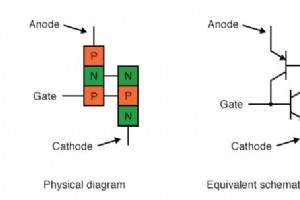
Shockley Diodes and Silicon Controlled Rectifiers (SCRs) Shockley diodes, while limited in scope, can be transformed into powerful amplifying devices—called silicon‑controlled rectifiers (SCRs)—by adding a single latch mechanism. This third terminal, the gate, enables the device to latch into conduc

DIACs are a specialized class of unidirectional semiconductor devices—essentially Shockley diodes connected in parallel with opposite polarity—to create a bidirectional trigger element for alternating‑current (AC) circuits. When a single Shockley diode conducts, it allows current flow in only one di
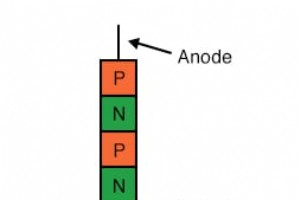
Our journey into thyristors starts with the four‑layer PNPN device, commonly called a Shockley diode after its inventor, William Shockley. It should not be confused with the Schottky diode, which is a two‑layer metal‑semiconductor junction known for its rapid switching. Textbooks often depict the Sh
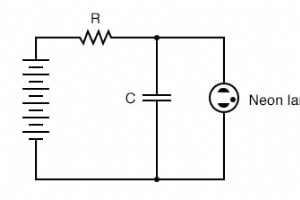
Witnessing a lightning storm reveals the phenomenon of electrical hysteresis—though most observers are unaware of the physics behind it. Wind and rain accumulate static charges between cloud and ground, and among clouds themselves. These charge imbalances produce high voltages. When the insulating p
Thyristors are semiconductor devices that exhibit hysteresis—a behavior where the device remains in its current state even after the triggering stimulus is removed. A classic illustration is a toggle switch: once you push the lever, it snaps to one of two stable positions and stays there until you m
Industrial Technology