


Industrial manufacturing
Industrial Technology


Field‑effect transistors are common in power‑switching applications. This article explains how a junction field‑effect transistor (JFET) can serve as an efficient on/off switch in a simple lamp circuit. The JFET’s conduction path runs between its source and drain terminals. In the schematic below,
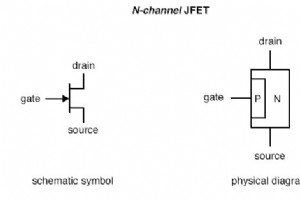
A transistor is a linear semiconductor device that controls current using a low‑power electrical signal. Transistors fall into two main families: bipolar and field‑effect. While bipolar transistors use a small current to regulate a large current, field‑effect transistors (FETs) rely on a small volta
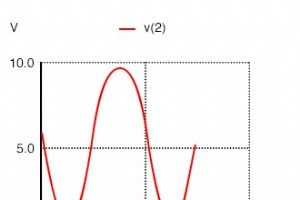
In an ideal world a transistor would amplify signals with zero distortion, unlimited frequency reach, and handle large currents at high temperatures. In reality, every BJT exhibits non‑idealities that limit performance. This article explains the key quirks—nonlinearity, temperature drift, thermal ru
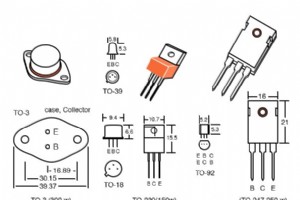
Transistors, like all semiconductor devices, have finite voltage and current limits beyond which they fail. Because of their complex internal structure, BJTs exhibit a broader set of rating parameters than simpler components. The following sections detail the most common specifications you’ll encoun
Bipolar Junction Transistor or BJT Current Mirror A current mirror is one of the most widely used BJT circuits. It acts as a simple, reliable current regulator, maintaining a nearly constant current through a load over a broad range of load resistances. In active mode, the collector current (IC) eq
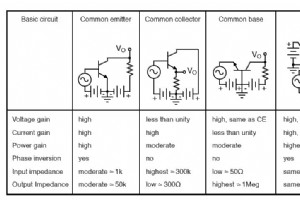
Input impedance in transistor amplifiers varies markedly with circuit topology and biasing. While the true impedance is complex and frequency‑dependent, practical approximations give clear guidance for the three basic configurations. For the common‑collector (emitter follower), the input resistance
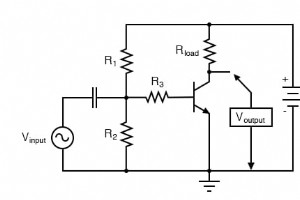
Understanding Amplifier Feedback\nIn an amplifier, a portion of the output signal can be routed back to the input. This intentional coupling is known as feedback and is a cornerstone of modern electronics.\nTypes of Feedback\nFeedback is generally categorized into two distinct flavors:\n\nPositive (
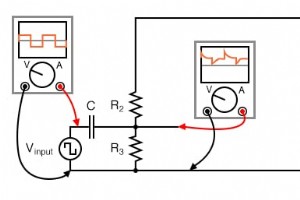
Overview When designing an amplifier, the challenge is often to supply the necessary DC bias to the input signal without inserting a battery in series with the AC source. A common solution is to use a voltage divider across the DC supply and couple the AC input to the divider with a capacitor, formi
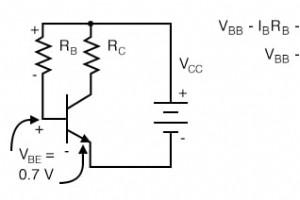
Transistor switching circuits can function without bias, but almost all analog designs rely on a carefully set bias point. This guide walks through the most common biasing topologies—base‑bias, collector‑feedback, emitter‑bias, and voltage‑divider bias—and shows how to choose resistor values to ach
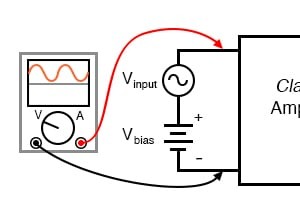
During the common‑emitter section of this chapter, a SPICE simulation revealed a half‑wave‑rectified output: the transistor failed to remain in its active region during half of the input cycle. To preserve the full waveform, a small bias voltage was introduced, keeping the transistor in the active m
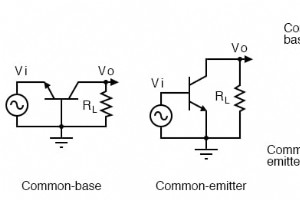
While the common‑base (C‑B) amplifier offers a broader bandwidth than the common‑emitter (C‑E) stage, its input impedance—tens of ohms—restricts its usefulness. A common solution is to precede the C‑B stage with a low‑gain C‑E driver that presents a higher input impedance in the kilo‑ohm range. The
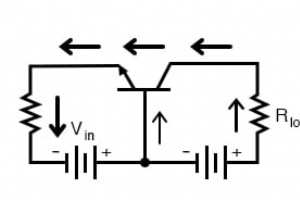
The common‑base amplifier is the most uncommon of the three basic transistor configurations, largely because its operating characteristics differ markedly from the common‑emitter and common‑collector circuits. This section examines its structure, key performance metrics, and typical use‑cases. Wh
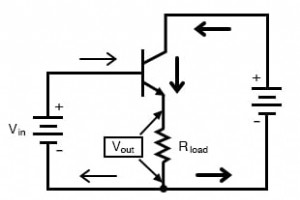
In transistor amplifier design, the common‑collector configuration—often called the emitter‑follower—offers a simple yet powerful solution for voltage buffering and current amplification. Below, we break down its operation, key characteristics, and practical uses. What Is the Common‑Collector Confi
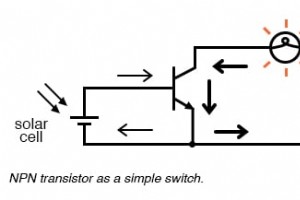
The common‑emitter configuration is a foundational transistor circuit that serves both as a robust switch and as an effective amplifier for analog signals. By operating between its saturation and cutoff limits, a transistor can precisely control collector current, enabling linear amplification of in
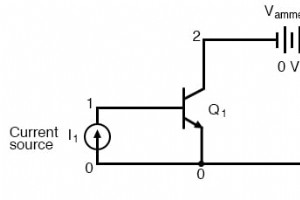
When a bipolar junction transistor (BJT) is completely off, it is said to be in the cut‑off state, behaving like an open switch. When it conducts to the maximum extent permitted by the supply and load—so that the collector current (IC) is as high as the circuit allows—it is said to be in the saturat
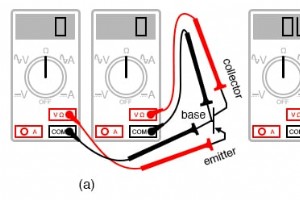
Bipolar transistors are fabricated as a three‑layer semiconductor sandwich—either PNP or NPN. When a multimeter is set to the resistance or diode‑check mode, a BJT behaves like two back‑to‑back diodes. This simple test lets you verify the device and identify its pins without a datasheet. When tested
Bipolar Junction Transistors (BJTs) are versatile components that can function as amplifiers, filters, rectifiers, oscillators, and, importantly, switches. When biased into the linear region, a BJT behaves as an amplifier; when biased into saturation or cutoff, it acts as a power switch, allowing or
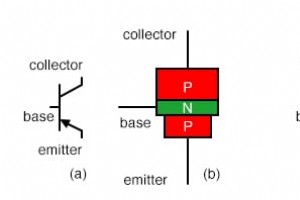
Since its invention in 1948, the bipolar transistor has transformed electronics, replacing bulky, fragile, and power‑hungry vacuum tubes with compact, robust, and energy‑efficient silicon devices. This breakthrough enabled the creation of lightweight, cost‑effective electronics that underpin modern
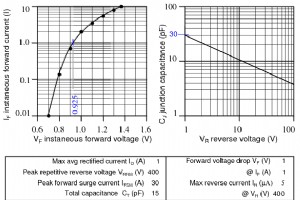
SPICE is the industry‑standard for circuit simulation, and diodes are one of its most frequently modeled components. A diode’s behaviour is captured in SPICE through two statements: the device element and the model definition. The element statement connects the diode to the circuit, while the mode
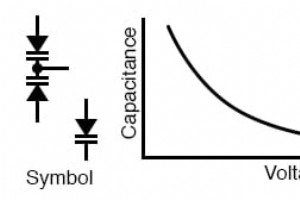
Varicap or Varactor Diodes Varicap diodes, also called varactors, are reverse‑biased junctions whose depletion width—and thus capacitance—varies with applied voltage. The effect is especially pronounced in varicaps, allowing precise tuning of resonant circuits. The schematic below shows a common‑cat
Industrial Technology

Avoid Common Injection Molding Defects: 7 Key Pitfalls & Prevention Strategies
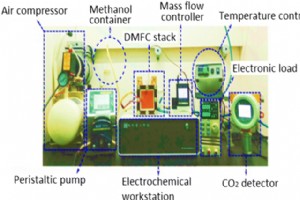
Platinum‑Based Catalysts on Carbon Supports and Conducting Polymers for Direct Methanol Fuel Cells: A Comprehensive Review

BLE Bot 9000: Advanced Bluetooth‑Enabled Arduino Robot Kit

Real Python Office Hours: Live Q&A Sessions for Python Learners
